What Would Jesus Do With the Welsh Red Dragon Flag?

National Identity, the Red Dragon, and a Vision That Reaches Further Than Any Flag

Jesus was from somewhere. That is easy to overlook, but it matters.
He was from Nazareth: a small, undistinguished town in Galilee, part of a people living under the occupation of the Roman Empire.
He spoke Aramaic, the everyday language of His community. He grew up shaped by a particular culture, a particular history, a particular set of stories and songs and losses. He was, in every meaningful sense, located.
And that matters, because it means that when we ask what Jesus makes of national identity, of flags and languages and cultural pride, we are not asking what some rootless, culture-free religious teacher thinks. We are asking someone who knew from the inside what it felt like to belong to a people with a complicated and often painful history.
So: what would He do with Y Ddraig Goch, the Welsh Red Dragon?
He grew up in a culture where boundaries between peoples were sharp and significant. Jews and Samaritans had centuries of mutual suspicion and contempt behind them. Gentiles, non-Jewish peoples, were in a different category entirely for most of His contemporaries. The question of who belonged and who did not was live and urgent.
And yet Jesus kept doing things that surprised and sometimes scandalised the people around Him. He spoke to a Samaritan woman at a well, at length, in public, something no respectable Jewish teacher would have done. He healed the daughter of a Syro-Phoenician woman, a Gentile, when His disciples thought she was quite simply not their concern.
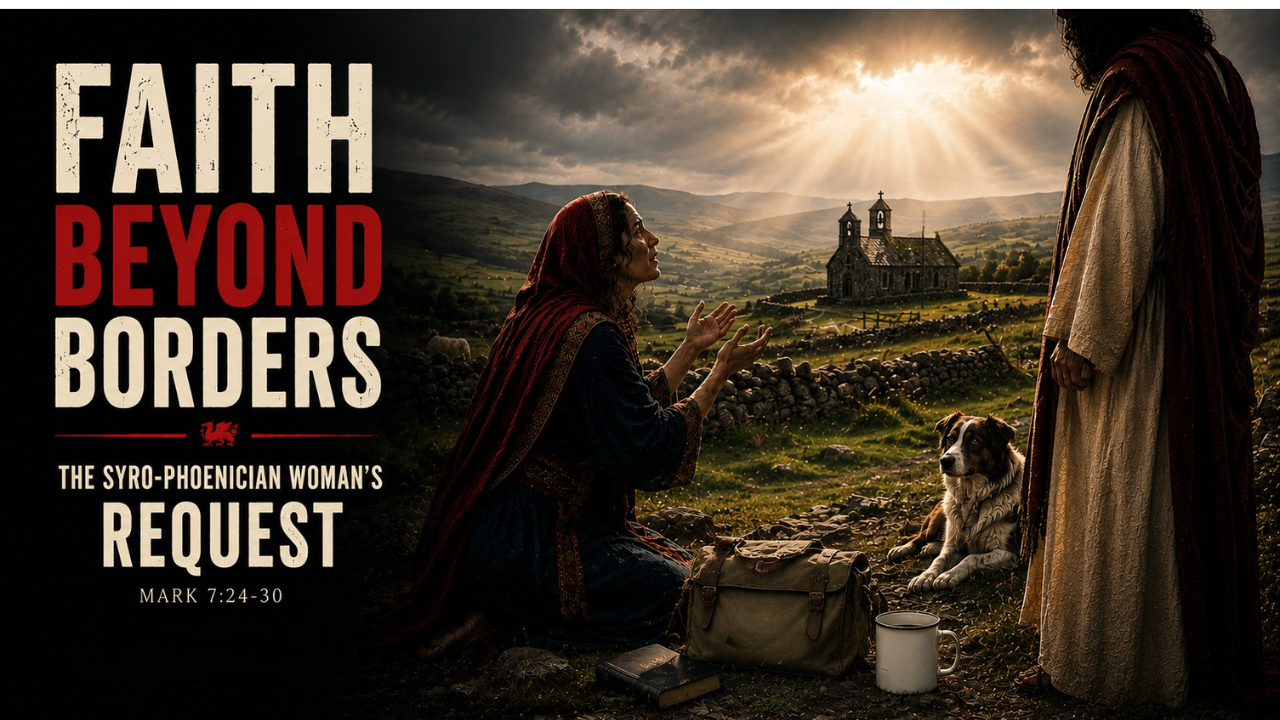
He told a story in which the hero turned out to be a Samaritan, the despised outsider, and the respected religious insiders turned out to be the ones who walked past. Every time His culture drew a line and said "not our kind of person," Jesus quietly and deliberately stepped over it.
He was not doing this randomly. He had a vision, drawn from the Hebrew Scriptures He had grown up reading and loving, of a God whose purposes were always wider than any single nation. The prophets had said that all nations would eventually stream toward the mountain of the Lord. The Psalms sang of a King whose dominion would reach to the ends of the earth. The story of Israel was never, in its deepest reading, just about Israel. It was about what God was doing through Israel for the sake of everyone.
Jesus took that seriously. More than seriously: He embodied it.
So what does He say about Y Ddraig Goch?
I think He says: love it. Be Welsh, joyfully and unashamedly Welsh. Speak the language if you have it. Sing the songs. Grieve the losses in your history, because there are real losses worth grieving. Celebrate what has survived, because survival against the odds is something worth celebrating. Your identity, your culture, your place in the world: these are not things to be embarrassed about or discarded in the name of some vague cosmopolitanism.
And then He says something else. He says: remember that your deepest identity is not written on any flag. It is written in the wounds of a Lamb, a Lamb without spot and without blemish, who laid down His life for the salvation of His followers, followers who are represented in every tribe, language, people, and nation.

Many of our Welsh forebears understood this instinctively. The great revivals of Welsh history did not produce people who stopped being Welsh. They produced people who were more fully themselves, and at the same time found themselves part of something that reached further than Wales, further than Britain, further than any earthly border.
The flag can be loved. But it cannot bear the weight of your ultimate identity. Only the Lamb can do that.
The question He leaves with us is the question He always leaves: are you in?
Quiz:
- Where was Jesus from, and why does this matter for the question the blog post is asking?
- Name two examples from Jesus' ministry where He crossed a significant cultural or ethnic boundary.
- What vision, rooted in the Hebrew Scriptures, shaped Jesus' approach to national identity?
- According to this reflection, how should a Welsh Christian hold their national identity?
- What does "your deepest identity is written in the wounds of a Lamb" mean in your own words?

Rock, Empire and the Question That Changed Everything - Mark 8:27-38