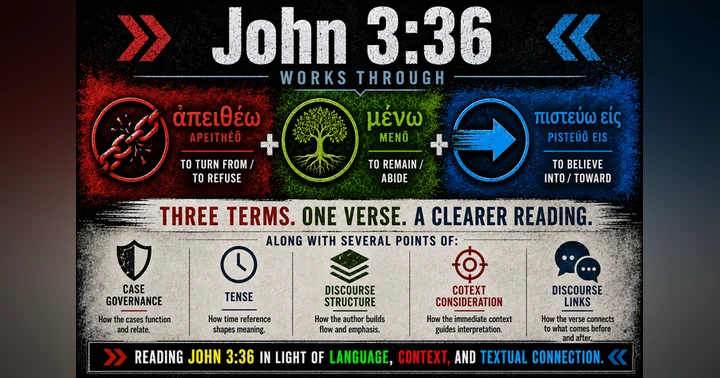
The Afternoon That Changed Everything - getting close in with Mark 5:21-43
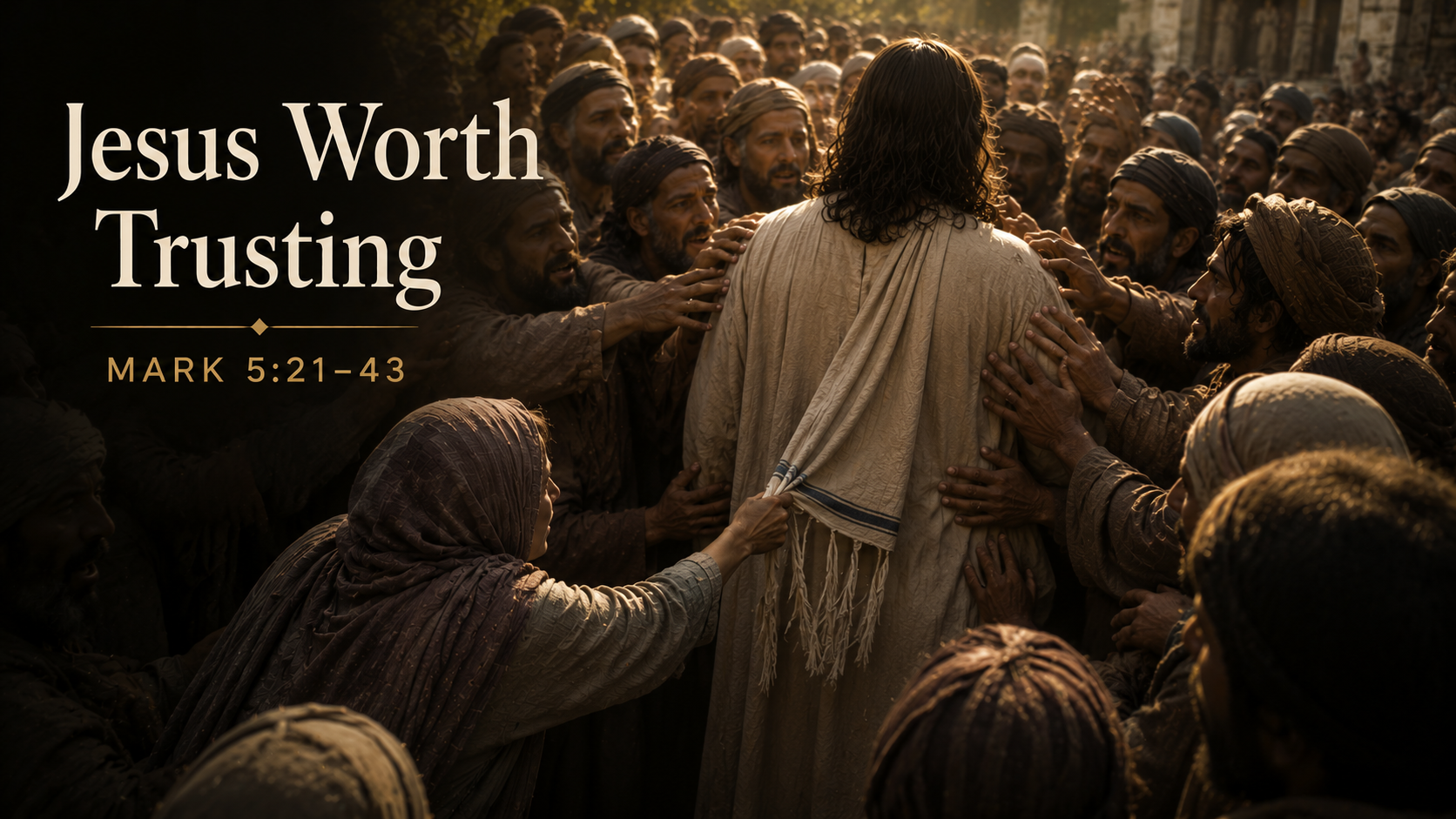
Today we dig into a 'slow burner'.
What I'm suggesting is that there are passages in the gospels that you get to grips with only slowly.
It can take years.
You think you know them, and then you read them again and something you missed the first dozen times suddenly stands out and you wonder how you ever passed it by.
Mark 5:21-43 is one of those passages.
On the surface it is two miracle stories from a busy afternoon in the ministry of Jesus ...
A synagogue ruler whose daughter is dying.
A woman with a long-term illness who touches Jesus in a crowd.
A resurrection and a dramatic healing ... two remarkable things happening in the same few hours.
But Mark is doing something considerably more sophisticated than recording two remarkable things.
He is building a carefully constructed literary and theological unit in which the two stories are placed inside each other deliberately, each one interpreting the other, the whole package turning out to be greater than the sum of its parts.
And it's when you read it that way, as a single well crafted three act play rather than two separate and unrelated incidents, that the passage opens up in ways that have a very direct bearing on
- how we understand Jesus,
- how we understand the nature of faith, and
- how we understand ourselves.
The Shape of It
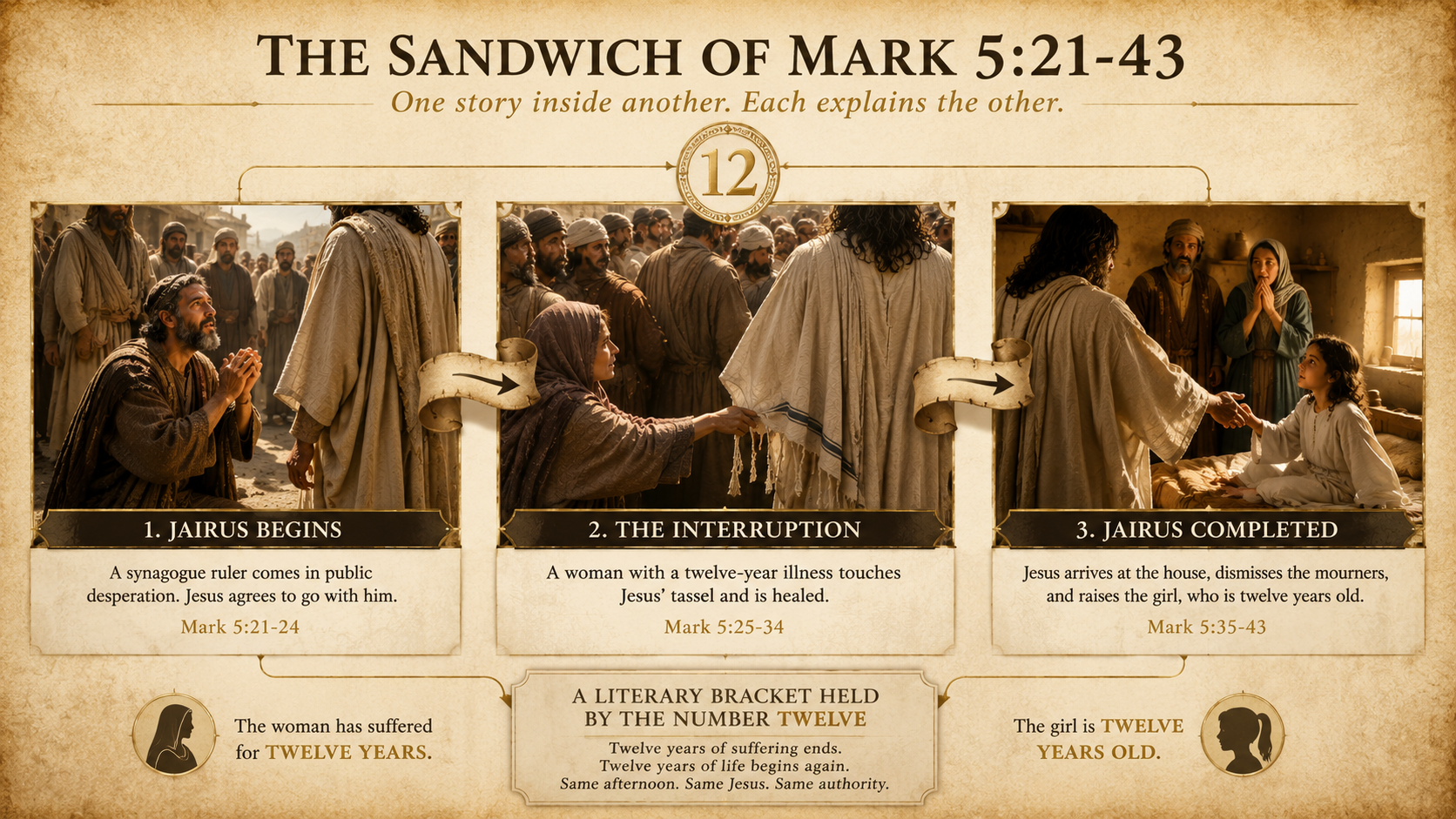
Mark has a literary habit that scholars call 'intercalation' ... what a fantastic word to play with!
What it means is that Mark begins a story, interrupts it with another story, completes the interruption, and returns to finish the first story.
It's a writing device that pops up a lot in his gospel:
- the fig tree and the temple cleansing in chapter 11,
- the sending of the twelve and the death of John the Baptist in chapter 6, and
- the anointing and the betrayal in chapter 14.
It's a complicated enough way to write that it has to be intentional ... it is never simply decorative. It's deliberate and the two stories always interpret each other at a depth that neither achieves alone.
Here the intercalation works like this.
Jairus comes to Jesus in public desperation.
Jesus agrees to go with him.
On the way, the woman touches Jesus and is healed.
Jesus stops, draws her out, speaks to her.
While he is still speaking, messengers arrive from Jairus's house and brutally announce: 'Give it up with Jesus, your daughter is dead'.
But Jesus continues to the house, dismisses the mourners, and raises the girl from the dead.
As an afternoon's work, it presents a pretty good answer to the question of chapter 4 ... 'Who IS this, that even the wind and waves obey Him?' By now we know not only the creation obeys His word of command, but also the powers of darkness, sin, sickness ... and now ritual defilement and death.
Cleverly, Mark builds a bracket that holds both stories together, and it is the number twelve.
The woman has suffered for twelve years.
The girl is twelve years old.
Two lives running in parallel, one slowly diminishing, one just arriving at the threshold of everything it might become.
Mark closes the bracket at the end of the passage by telling you the girl's age after the resurrection: twelve years of age. He opened it when he introduced the woman's condition. Twelve years of suffering ends in a sentence. Twelve years of life, apparently ended, begins again.
Same afternoon.
Same Jesus.
Same authority.
So you've met the women, now meet Jairus.
Jairus: The Risk of Public Faith
Jairus is a named figure, which in Mark always carries weight.
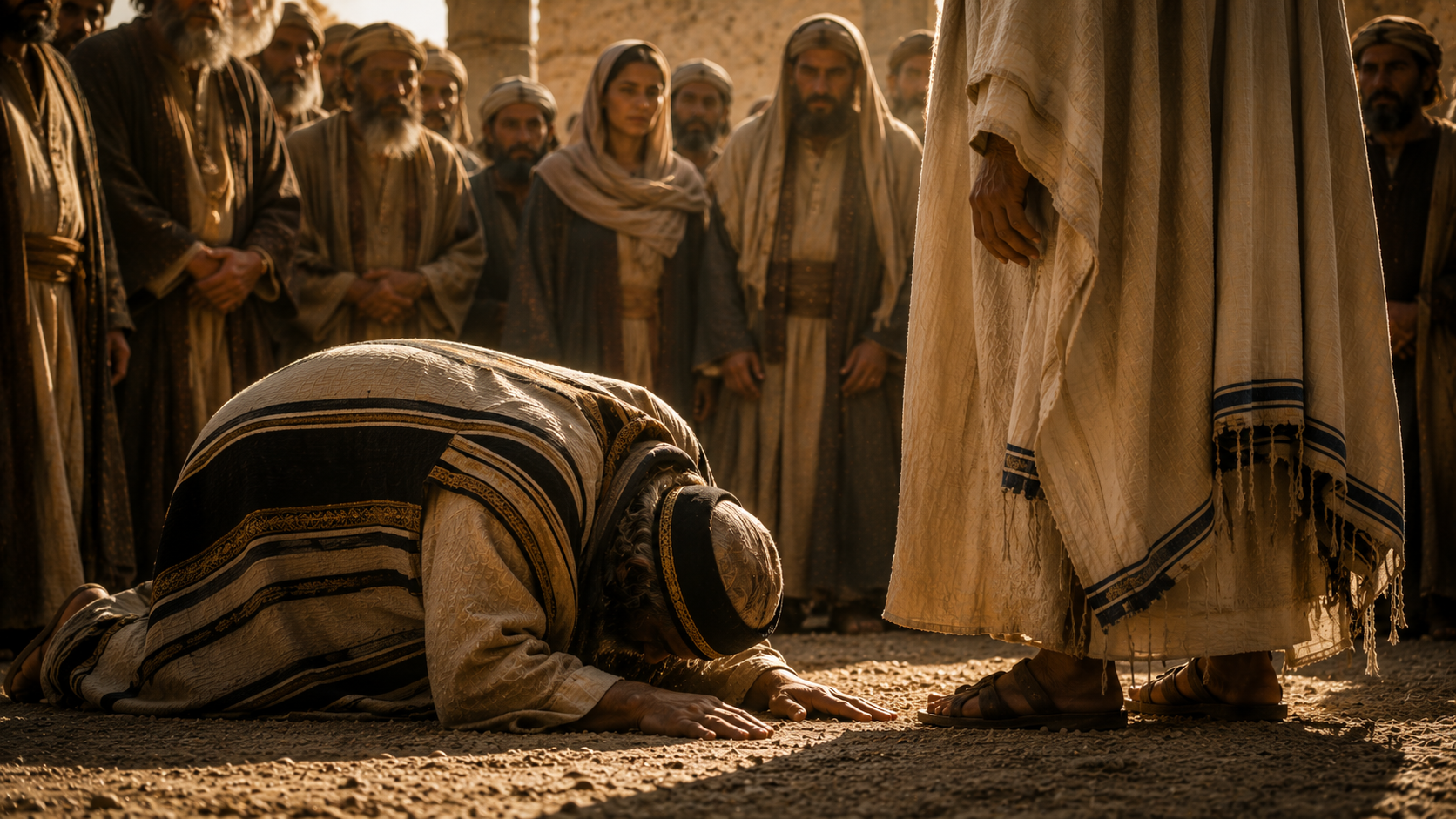
And there's more. We're told He is the archisynagogos, the ruler of the synagogue, which means he had administrative responsibility for the worship life of his community. He was a known man, a respected man, a man with institutional identity and social standing.
And he falls at Jesus's feet in public.
Every Christian who has ever felt the tension between public faith and professional reputation will recognise something in that moment.
Jairus is not making a quiet private enquiry. He is prostrating himself in front of a crowd at the feet of a teacher whose relationship with the synagogue establishment was already 'complicated', to put it mildly.
Jairus does it anyway, because his daughter is dying and nothing else matters to him in that moment.
Desperation is one of the great clarifiers of priority. When the thing you love most is at the point of death, the concern for reputation can resolve itself quickly.
But Jairus's faith is not only tested at the beginning of the story. It is tested far more severely in the middle of it, at the moment the messengers arrive with news that the girl has already died. Whatever faith brought him to Jesus's feet is now asked to operate in a context where its object appears to have been removed.
The thing he was hoping for from Jesus is gone.
And Jesus says: do not fear. Only believe.
Four words in the Greek. Me phobou, monon pisteue.
It is not a comfort. It is a command. And it is given at the precise moment when obedience to it is hardest.
This is worth pondering for any of us who have found ourselves in the place where faith has apparently lost its footing, where the situation has moved past the point where believing seems to have any purchase on reality.
Notice please Jesus simply does not explain.
He does not apologise for running late.
He does not offer a reassurance about what He is going to do.
He simply asks for trust in Himself, personally, specifically, and in the dark.
He also, we can miss this but this is actually one of Mark's most careful structural moves, gives Jairus a demonstration before he gives him the demand.
The woman's healing happens first.
Jairus watches it.
He sees what believing at the extremity looks like when it is enacted by a real person in a real situation.
He is shown the possibility before he is required to inhabit it.
The demand of verse 36 is prepared for by the demonstration of verses 25 to 34. And this is characteristic of how Jesus operates.
We are rarely asked to trust in a direction we have not first been shown is possible, though the showing is not always obvious or labelled ... and we can certainly miss itif we're not on the ball.
The Woman: Reaching From the Outside
The woman in this story has no name. That is the first structural signal. Jairus has a name, a title, a house, a family, a social location. The woman is defined entirely by her condition.
What condition? Well it's physical but the pain doesn't stop there.
She has been bleeding for twelve years.
Now, under the purity regulations of Leviticus 15 this made her ritually unclean, with all the social and religious consequences that entailed.
She could not participate in synagogue worship.
Contact with her rendered others temporarily unclean.
So on topof her physical condition she had ben living for twelve years at the margins: untouchable, effectively invisible, excluded from the community life that in her culture was inseparable from daily existence.
By that afternoon she had spent everything she had on physicians. She is no better. She is worse.
But now she had heard about Jesus.
She reached through the crowd and touched the hem of his garment, the kraspedon, the tassel on the corner of his outer robe.
Mark specifies exactly where she touches, and the specification matters.
The Hebrew word for the corners of the garment is kanaph, the same word used in Malachi 4:2 for the wings of the sun of righteousness in which healing is promised for the coming Messiah.
he Aramaic targum used in synagogue worship rendered those wings explicitly as the tzitzit of the Messiah.
Whether this woman reached for Jesus with that prophecy consciously in mind, or whether she simply reached for Jesus because reaching for Jesus was the last thing she had left, Mark knows the significance of where she touched.
He tells you precisely because that precisely is the point.
The woman is immediately healed.
And Jesus stops.
In the middle of an urgent journey to a dying child, he stops.
He turns.
He asks who touched him.
The disciples are baffled, reasonably enough, by a question that seems unanswerable in a pressing crowd.
But Jesus waits, because he knows the difference between the crowd pressing in and someone actually reaching for him. Those are not the same thing. They have never been the same thing.
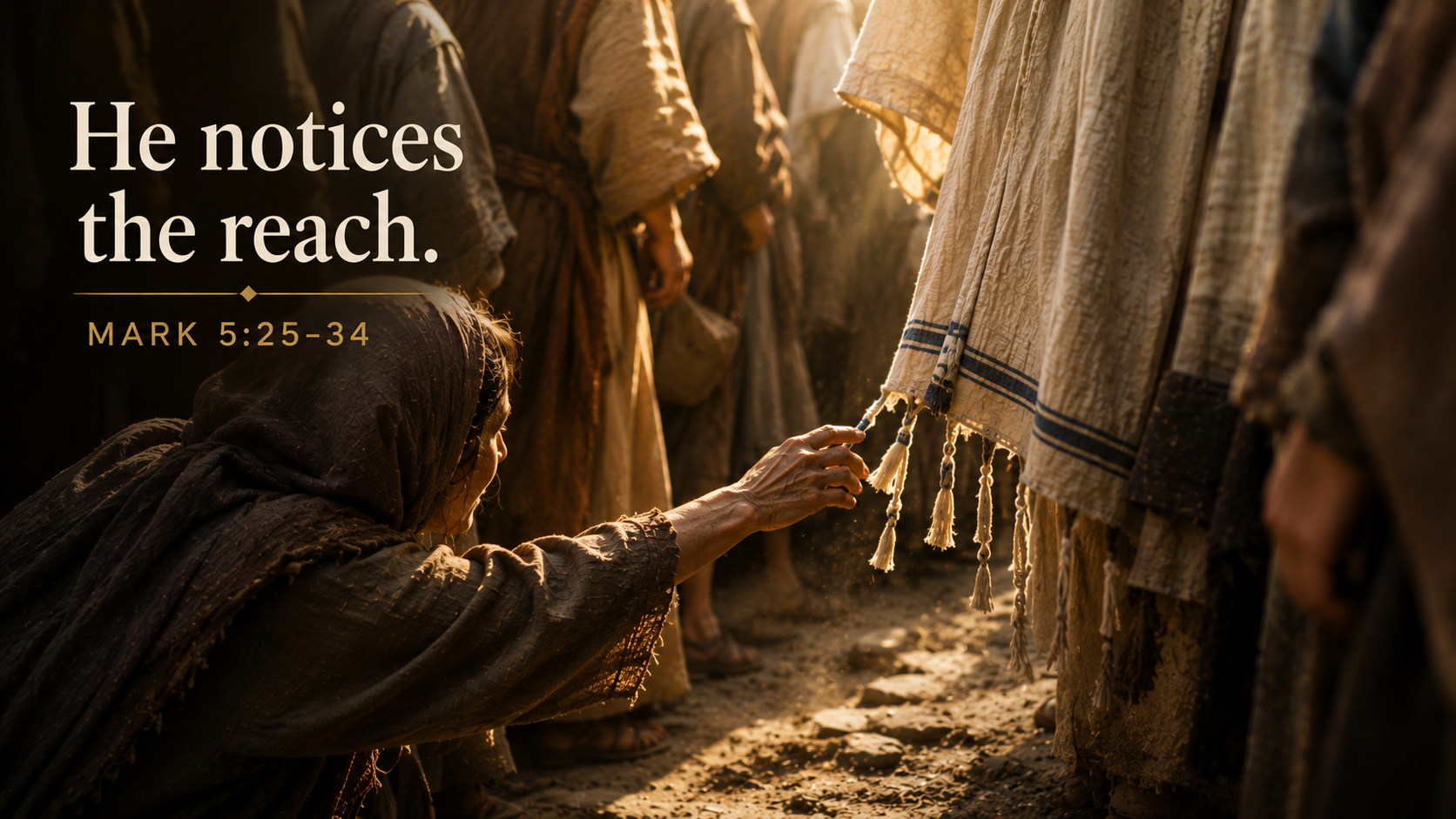
The woman came forward in fear and trembling. She told him everything. And Jesus spoke four new realities into being in her life.
- He calls her daughter. In public. Before the crowd. The same word Jairus used for his little girl. She came to him unnamed and untouchable. He names her into the family.
- He names her action as faith. Not desperation, not superstition, not a last resort. Pistis. Deliberate, costly, directed trust in his person. That is the category he places it in and it is the category that matters.
- He sends her away in peace. The shalom behind that phrase is not the absence of distress. It is the full flourishing of a life restored to wholeness.
- He commands the healing into permanence. Be healed of your disease. Not a temporary remission. Done.
There is something here for every Christian who has ever felt that their particular history, their particular condition, their particular sense of being outside or unqualified, puts them beyond the reach of what Jesus offers.
The woman in this story was outside by every available measure: social, religious, financial, physical, and Jesus stopped for her, listened to her whole story, and commanded that she must belong.
He notices the reach. He always notices a person's desperately hoping, trusting reach.
And on He went to the desperate house of Jairus.
The House: Authority Over the Final Boundary
The scene at Jairus's house is almost startling in its directness.
By the time Jesus arrives the professional mourners are in full operation: the noise, the weeping, the organised expression of communal grief that was the entirely appropriate and expected response to death in a first century Jewish household.
It's too simplistic to call these people hypocrites. This is their culture doing what their culture does.
In the heat of the action, Jesus walks in and tells them the child is not dead but sleeping.
They laugh at him. Mark's word is kategeloon, laughed him down, derisively and contemptuously.
These are professionals in the presence of death telling an outsider he doesn't understand what he's looking at.
Jesus just puts them outside without argument, and goes in to the child.
And then comes the moment the whole passage has been moving toward. Two words ... and two only.
He takes her hand. He speaks to her. And Mark, writing in Greek for a Greek speaking world, stops with the Greek and gives us the precise Aramaic words Jesus used.
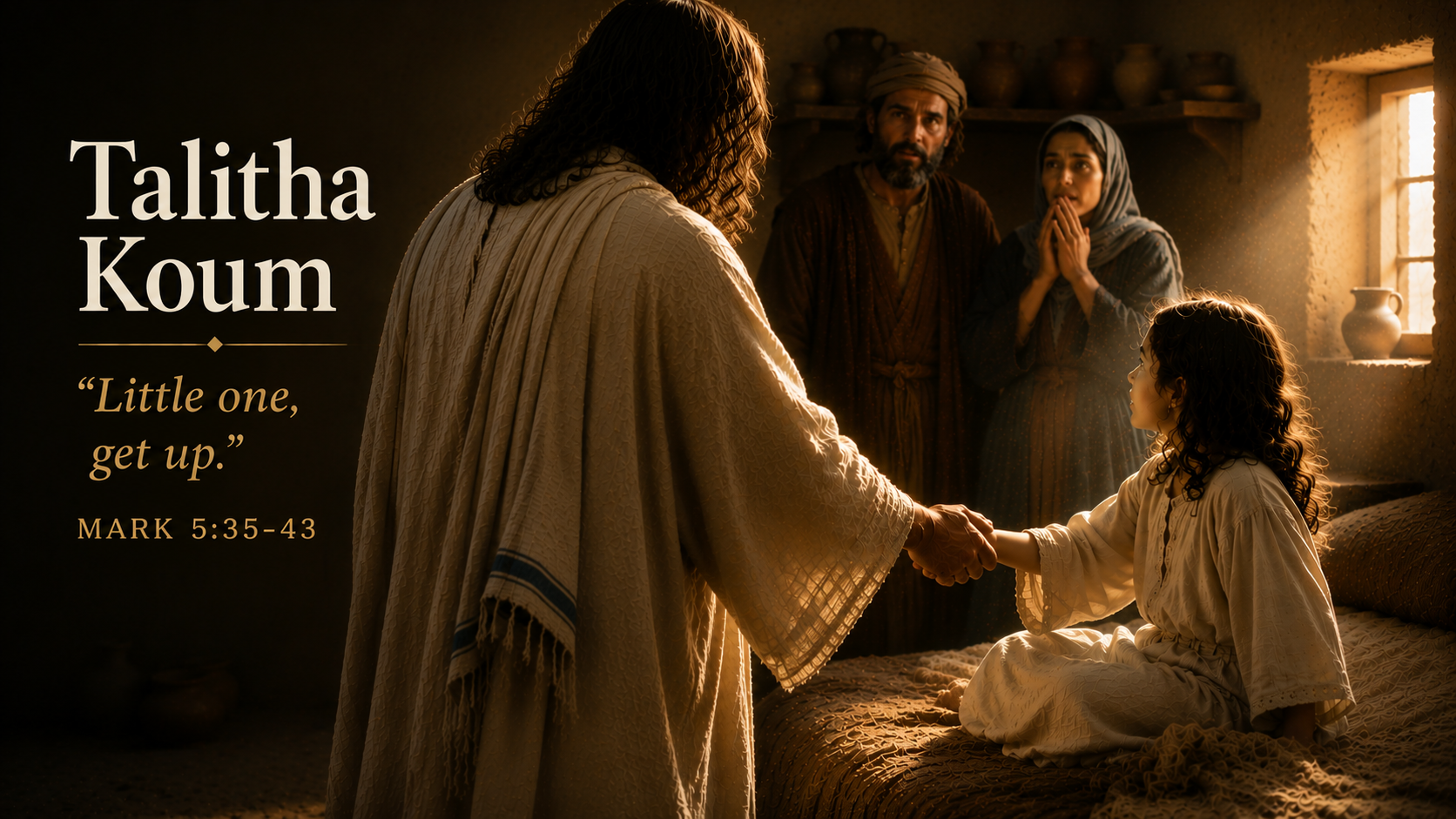
Talitha koum.
Little one, get up.
We know that because someone in that room never forgot those words ... not just the sense of them, but the actual words in the actual language, passed on with such accuracy and fidelity across decades of telling that those Aramaic words are still there inside the Greek text, preserved like a pressed flower in an old family Bible.
Unlike 'the synagogue ruler', Talitha is not a title or a formula.
It is a term of endearment, the kind of word you use to a small child you are very fond of.
I suppose you could say it's a bit like the way we use the word 'cariad'. It's something close to 'little lamb', 'little dear one'. Cariad covers it.
And then the second word Koum. That is, very simply, 'get up'. A gentle address and a plain command. No ritual. No invocation. Two words where anyone else would have needed a ceremony.
The girl gets up immediately and walks around.
And Jesus tells them to give her something to eat.
She is alive. She is twelve years old. She is probably hungry after her period of serious illness.
'Feed her', says Jesus.
This is the Jesus of Mark's gospel.
The one who stops for the invisible woman and calls her daughter.
The one who commands a devastated father to keep believing because he knows the command can be met.
The one who speaks to a dead child with a term of endearment and tells her to get up.
The one who, when the miracle is accomplished, thinks about whether she has had anything to eat.
The big takeaway point for us here is this:
Jesus is the kind of Saviour Who has both the authority and the heart for humanity that makes Him worth trusting ... trusting way past the point where trust seems to have lost its reason.
And the whole of this passage is Mark's evidence for that claim.
Check out Who and What Jesus is with a free copy of Marks Gospel which you can get for yourself in audio or text form here:
https://live.bible.is/bible/ENGNLH/MRK/1

Rock, Empire and the Question That Changed Everything - Mark 8:27-38