What Does Gethsemane Teach Us About Following a Crucified Messiah? Mark 14:32-42
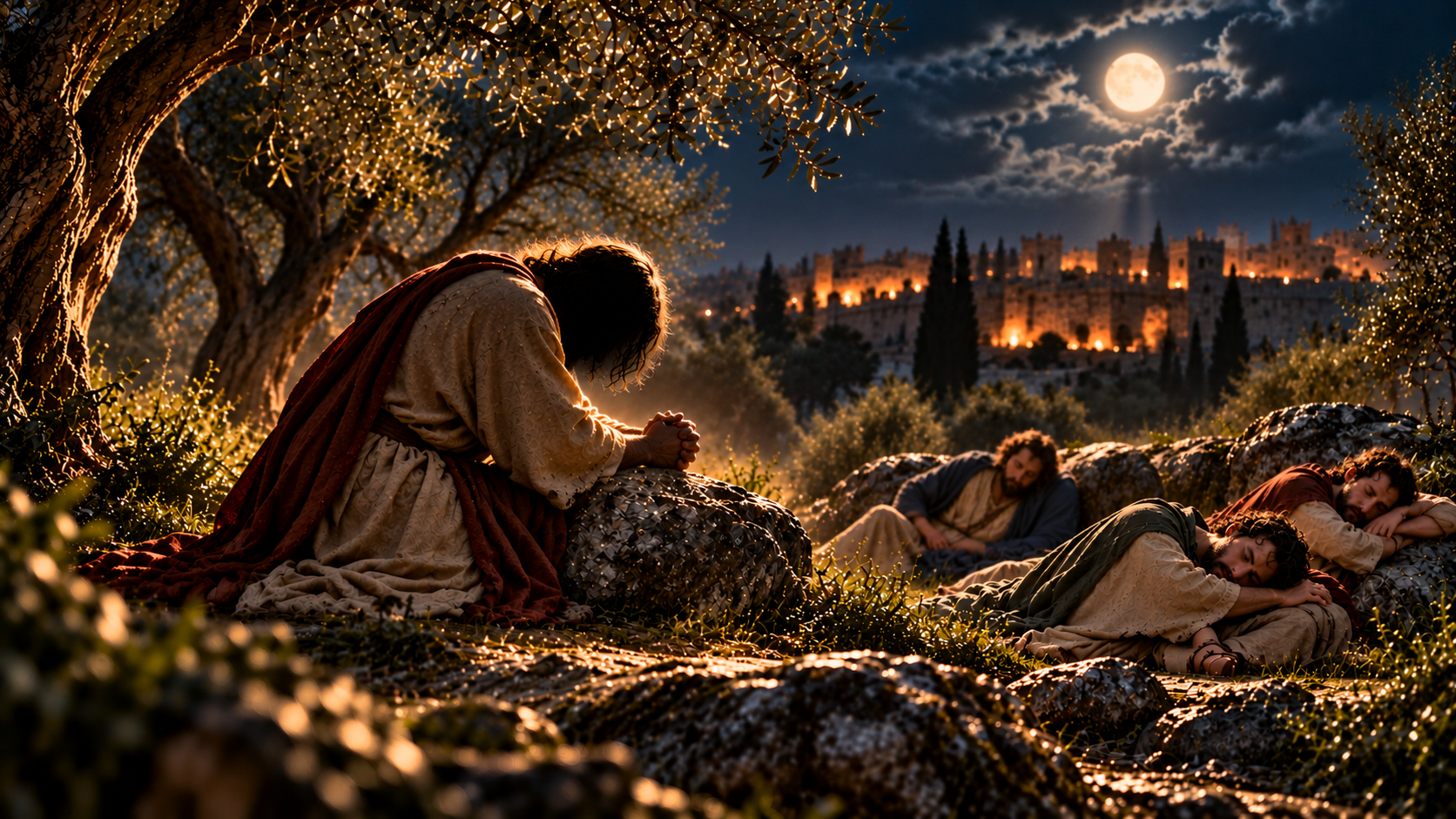
In Gethsemane, Mark shows Jesus facing the cost of the cross in real anguish, praying honestly, and choosing his Father’s will, while his three closest friends fail to keep watch.
It is the first of two lessons in how to follow a crucified Messiah: how to come through the inner turmoil.
The second, at Calvary in the next chapter, shows how to keep following when it costs the body.
Mark’s first readers needed both.
Where does Gethsemane fit in Mark’s Gospel?
Mark’s Gospel turns on a hinge.
In the first half, Jesus shows who he is by the authority of his word: he heals the sick, stills the storm, frees people from demonic control, raises the dead, and forgives sins. That half climaxes when Peter says, “You are the Messiah” (Mark 8:29).
From 8:31 the Gospel changes direction.
Jesus begins to teach that the Son of Man must suffer, be rejected, be killed and rise after three days, and Peter takes him aside to rebuke him (Mark 8:31-33).
The rest of the book then answers the question: what does it mean to follow a crucified Messiah, and how do you stay following him?
Jesus had put the cost plainly: anyone who wants to follow him must deny themselves and take up their cross (Mark 8:34).
In the garden we see him do the first half of that Himself.
Who first heard this story?
Most scholars date Mark to the middle or late 60s, and many place it in Rome, though that is not totally agreed on.
Either way, its readers lived with the memory of Nero’s persecution of Christians (if you're feeling adventurous you might want to search online for Tacitus, Annals 15.44).
In chapter 13, Jesus warned His followers that they will be handed over to courts and beaten (Mark 13:9-13).
Mark uses the same word of Jesus in our passage.
And given which Emperor they were living under, for these readers, “What does it mean to follow a crucified Messiah?” was not a theoretical question.
Why was a praying, frightened Messiah such a surprise?
Three contemporary expectations ran against what Mark shows us of Jesus here.
Firstly, many hoped for a victorious king of David’s line who would purge Jerusalem and defeat the nations. Popular movements in those decades looked for deliverance, sometimes by force. Mark describes for us the expected King/ Messiah lying on the ground in Gethsemane, praying almost desperately.
Second, many expected a final time of suffering before God’s rescue (Daniel 12:1), and some hoped to be spared it.
Thirdly, the ancient ideal of a good death was one that was calm and unafraid. And in fact a later critic of Christianity mocked the Gospels for showing Jesus afraid (Origen, Contra Celsum 2.23-24). For pagan Romans, this was not 'a good look'.
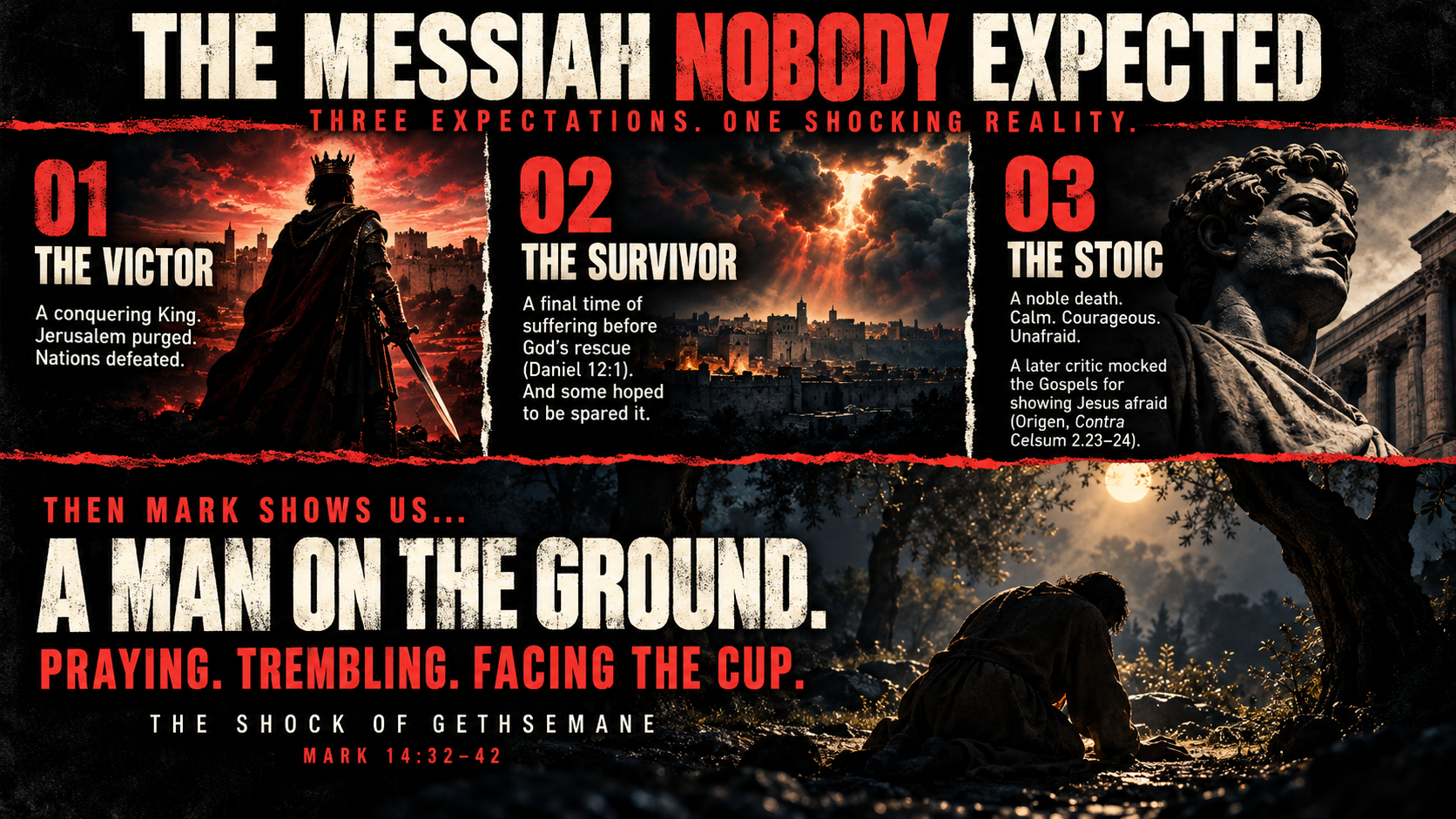
Clearly the disciples shared these expectations, which were going to be initially at least damaged by what they were experiencing here.
How does Mark structure his account?
Mark uses four movements: firstly there's an introductory setting of the scene, and then there are three rounds of Jesus's prayer and return.
Movement one: the circle narrows (verses 32-34).
Eight are left at the entrance.
Three are taken further. Peter, James and John, who had seen Jesus do the works of the Messiah as the dead girl was raised and as Jesus shone and was accredited by Heaven at the Transfiguration on the mountain were taken on to keep the Lord company as He went through this agony of spirit.
And for sure, they now seeing the other side of things.
Mark piles up three strong Greek words for Jesus’ state: there was shuddering alarm, there was acute distress, and there was being deeply grieved to the point of death.
The one who stilled the storm says he is overwhelmed to the point of death.
But what He request of His closest friends here is not “fix this.”
It is “Stay here, and watch.”
One Greek word needs a note here: γρηγορεῖτε (grēgoreite, keep awake, be alert). It is the word that closes Jesus’ great speech in chapter 13, where servants are told to keep awake lest the master come and find them sleeping, and where the four watches of the night are named (Mark 13:34-37).
The passion then follows those four watches of the night: evening at the table, the night in the garden, cockcrow when Peter denies him, and morning when Jesus is handed to Pilate (Mark 14:17, 72; 15:1). Some suggest that this is the night the warning in Mark 13 was all about.
The scene having been set, mark now takes us on into the three phases of Jesus' prayer and return to His sleeping 'watch mates'.
Movement two: the first prayer (verses 35-38).
Here Jesus prays that the “hour” He was so horribly experiencing might pass from him.
That word 'hour' is a thread through the passage:
the hour he asks to pass,
the one hour he asks his friends to watch, and
the hour that arrives. It echoes the Old Testament’s appointed time of the end (Daniel 8:17; 11:35; 12:1).
Here the Lord's prayer begins with “Abba”, Aramaic for “my father”, which Mark translates for his readers. It is not quite “Daddy”; it is an adult’s word as well as a child’s, but it expresses trust and closeness.
And then comes the request, “take this cup from me.” In the prophets the cup is often God’s judgement (Isaiah 51:17-22; Jeremiah 25:15).
And then, in the same prayer: “not what I want, but what you want.” The honest request and the willing surrender sit together. Mark records no answer that removes the cup.

Returning, Jesus finds them asleep and speaks to one man, by his old name: “Simon, are you asleep? Could you not watch one hour?” Not “Peter”, the rock ... the Peter who had promised to die with him cannot give him an hour.
Jesus is not in the business of recriminations and gives them a way through their immediate sense if guilt. He counsels them to watch and pray, so that they don't fall into testing. And then He seems to almost excuse them by acknowledging that for human beings “The spirit is willing, but the flesh is weak.” This is the Hebrew view of human beings as both enthusiastic and frail ... unable to delver on their aspirations ... all at the same time (Isaiah 31:3; Psalm 78:39). It is both a warning and a mercy.
Movement three: the second prayer (verses 39-40).
Mark compresses the substance of what he tells us Jesus prayed this second time into: “the same words.”
Nothing has improved here. They are asleep again, with eyes weighed down, and they have nothing to say. But again Mark records no rebuke from Jesus. The silence is probably there making the point.
Movement four: the third return (verses 41-42).
We might now be expecting the same pattern to repeat a third time, but Mark's account here breaks it.
There is no third prayer.
Jesus says, “The hour has come,” and announces that the Son of Man is being handed over. That verb is passive, which suggests that behind Judas, the priests and Pilate there is a purpose. It also echoes Isaiah’s Servant, who is handed over for our sins (Isaiah 53:6, 12).
But the passivity switches abruptly to intention: “Rise," says Jesus, "let us go.”
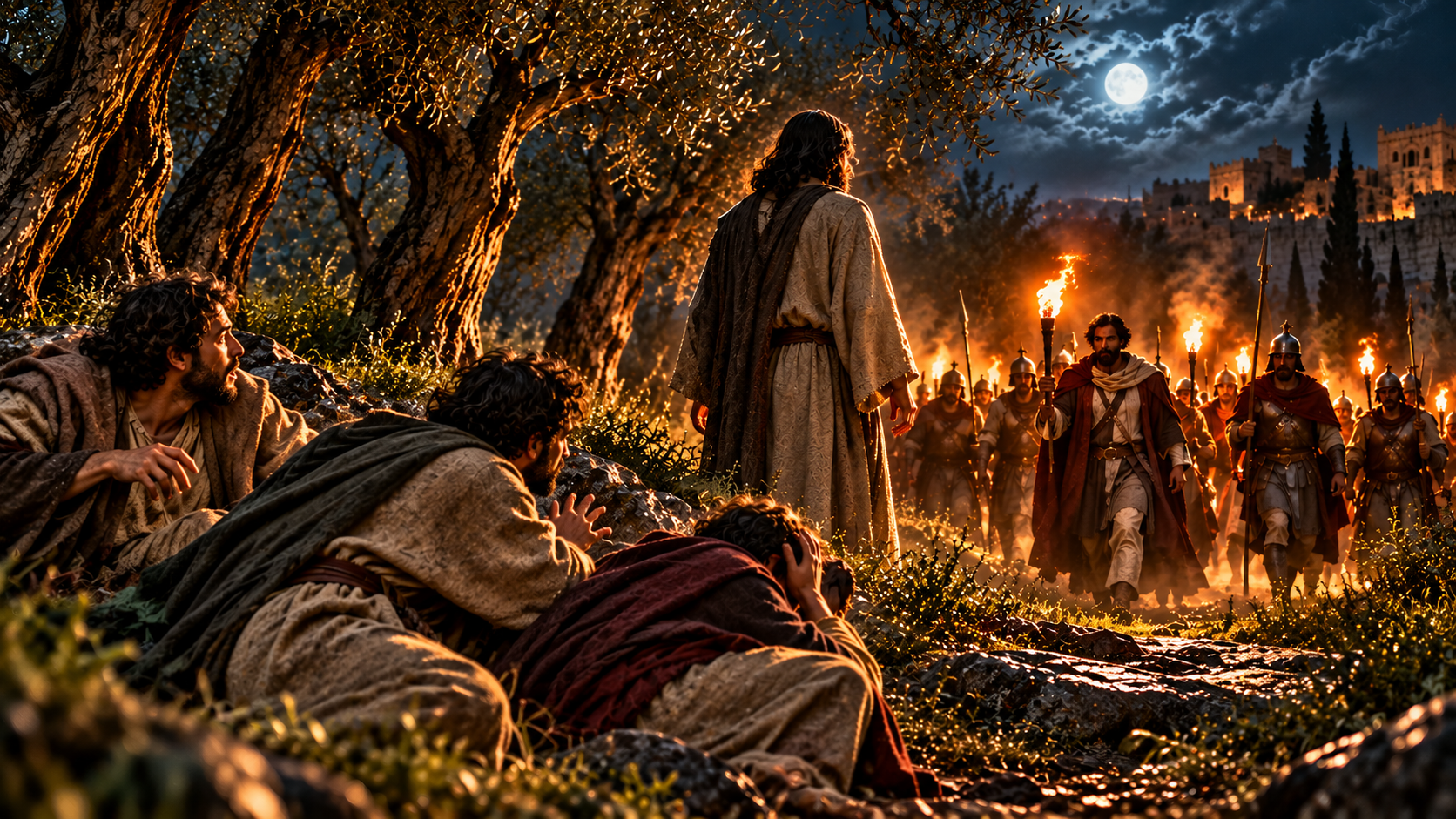
The One who was face down is the One who stands.
He is not dragged away.
In fact He takes the lead.
It's all too easy to criticise them from this safe distasnce, but for all the disciples' failures in this Gardden at Gethsemane, at this point they do the best their frail flesh can manage to stick around for Him.
They stayed, they failed, but the story does not end there
Look at what the three do.
Jesus tells them to remain, and each time he returns, they are still there (Mark 14:34, 37, 40).
They fail to watch, but they do not give up and walk away. And with Jesus’ last word in these episode He hasn't given up on them either ... He is still including them when He says “let us go”.
That is not the end of the story, and Mark does not pretend otherwise. In a few verses they all flee (14:50), and Peter denies him (14:66-72).
So where does hope and trust that Jesus puts in them come from?
Certainly not from their staying power.
Before any of it, Jesus says, “After I am raised up, I will go before you into Galilee” (14:28).
At the empty tomb, the message is for “his disciples and Peter” (16:7).
The faithfulness that holds this story together isn't the disciples faithfulness at all, it is clearly His.
What does this mean for us?
- Expect the road to be heavy. Not even the Messiah was spared inner turmoil on this road. If following him feels heavy, you are not doing it wrong.
- Pray honestly, then surrender. We tend to think we must choose between telling God what we want and trusting him. Jesus does both in one prayer to His Father ... and His example seems to be one we're invited to learn from.
- Do not rely on the strength of your promises. Peter’s vow was sincere and not enough. Jesus gives him a habit, watching and praying, not a bigger resolution.
- Failing is not the same as leaving, and failure is not final. He comes back to them three times.
- He goes first. The decision settled in the garden is carried out at Calvary. We need both lessons: how to pray through the turmoil, and how to keep following when the road is as hard as it looks.

Slow on the Uptake: Why Jesus Keeps Telling Us What We're Very Slow to Hear Mark 10:32-45