The Man Who Ran Up and Walked Away: Mark 10:17-31
How do you know you’ll be alright?
When the cold winters come, when the health goes, when the work dries up or the market turns, most of us have an answer, even if we’ve never said it aloud.
For some it is a bank balance or a pension.
For others it is a house, or land that has been in the family for generations.
For others still it is a good name, a clean record, or a safe job.
This week’s Word for the Week is about a man who had gone all in on that answer, and who ran to Jesus because something inside him was gnawing away at him that it wasn’t enough.
Where we are in Mark
From Mark 8:31, after Peter’s confession that Jesus is the Christ, Jesus begins to teach something new: the Son of Man must suffer, be rejected, be killed and rise after three days.
Three times He predicts it (8:31, 9:31, 10:33), and three times the disciples miss it.
The question has shifted from “Who is Jesus?” to “What does it mean to follow Him?”
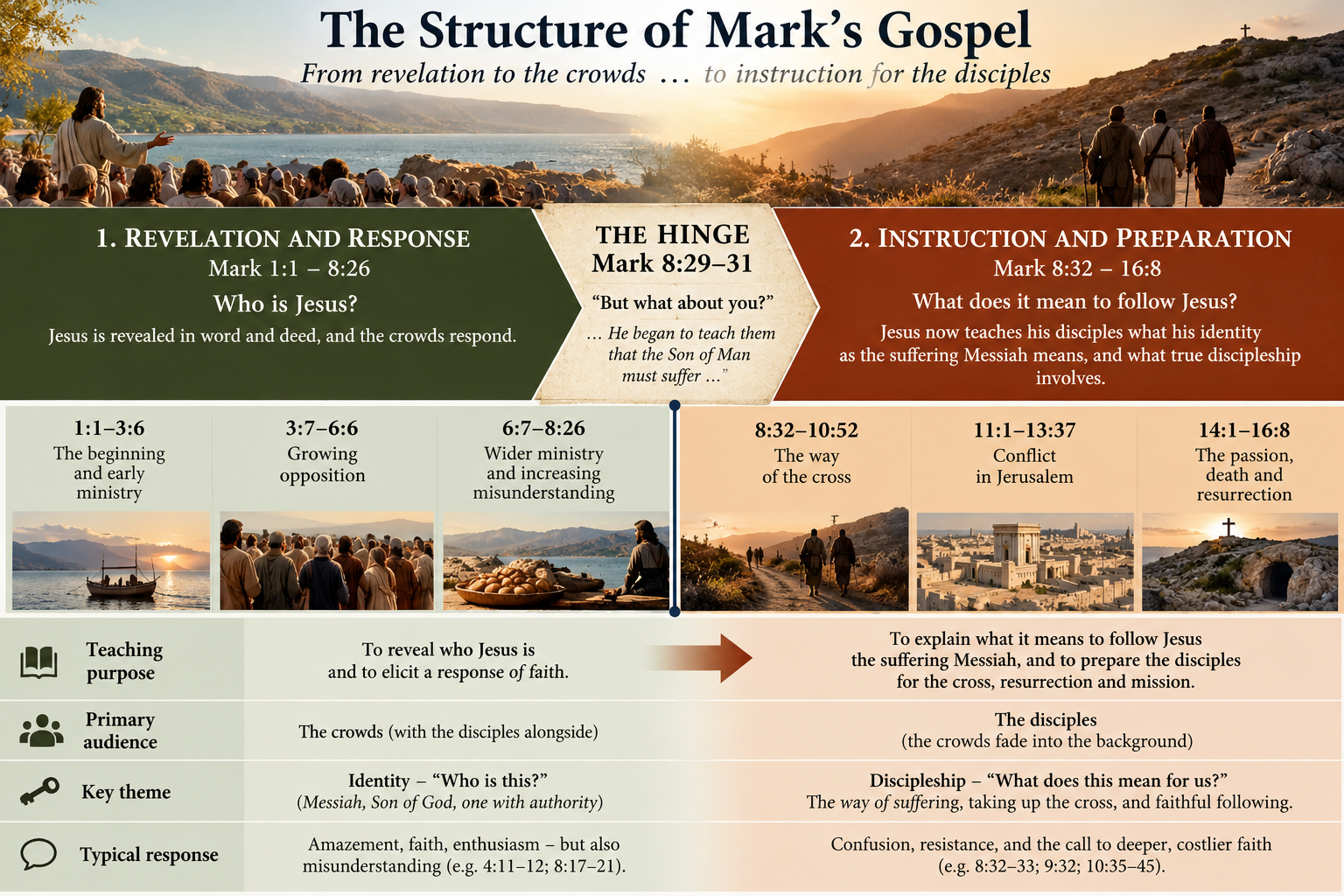
So this meeting with the rich man is not a stand-alone story about money. It is a stage on the road to the cross, with clear implications for Christ's followers.
The man and his question
A man runs up to Jesus, which was undignified in that culture, and kneels in the dust. He is eager, respectful and humble. He asks: “Good Teacher, what must I do to inherit eternal life?”
Two things stand out.
First, the word “inherit”: eternal life is the life of the age to come, received the way an eldest son receives the farm.
Second, he asks what he must do.
His world works like a spreadsheet: pay the right things in, build up credit, and be secure. His wealth looks to him like proof that God is pleased.
Straight off the bat Jesus asks, “Why do you call me good? No one is good except God alone.”
Jesus is not denying His own goodness.
He is pulling the man’s attention away from flattery and onto God as the standard.
Then He lists commandments, the second half of the Ten about how we treat each other, and adds “do not defraud”, the one a landowner with workers has most reason to watch.
The man replies honestly that he has kept them since boyhood, and we should take him at his word. He does seem to be an upright individual ... the sort of man you would want on the parish council!
Jesus looked at him and loved him
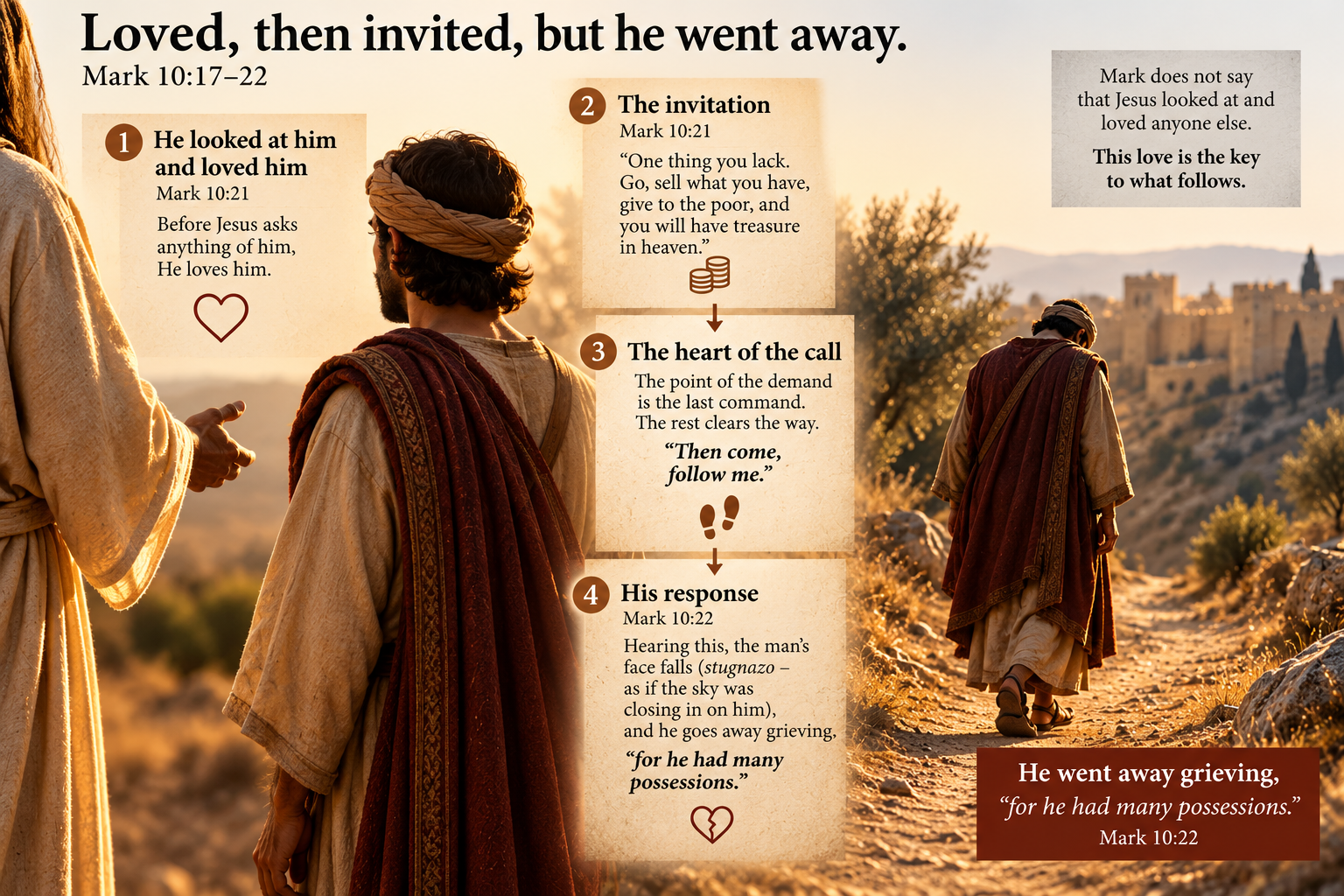
Mark 10:21 says Jesus looked at him and loved him.
Mark does not say this of anyone else.
But we're told that before Jesus asks anything of this man, He loves him.
That is the key to what follows, which sounds harsh without it: “One thing you lack. Go, sell what you have, give to the poor, and you will have treasure in heaven. Then come, follow me.”
The heart of the demand is the last command: follow me. The rest clears the way.
And hearing this the man’s face falls (Mark’s word, stugnazo, is how you'd say it felt like the sky was closing in on him), and he goes away grieving, “for he had many possessions.”
The word ktēma is property or land. And in fact it turns out it was his holding that was holding onto him.
Jesus is not saying everyone with much must sell everything.
He just simply names here the one thing that mattered for this man more than eternal life.
In his mind his wealth was his proof of safety and his evidence of being right with God. That was what he trusted in instead of Jesus.
So he went away sad on the day.
Interestingly though, Mark leaves the ultimate ending of this man's story open: he went away grieving, but we are not told that he STAYED away and was lost.
The camel and the needle
We're told the disciples were amazed by all of this.
If the respectable, wealthy man cannot get in, who can?
So Jesus addresses them tenderly as “children” and gives the image of the camel and the needle’s eye.
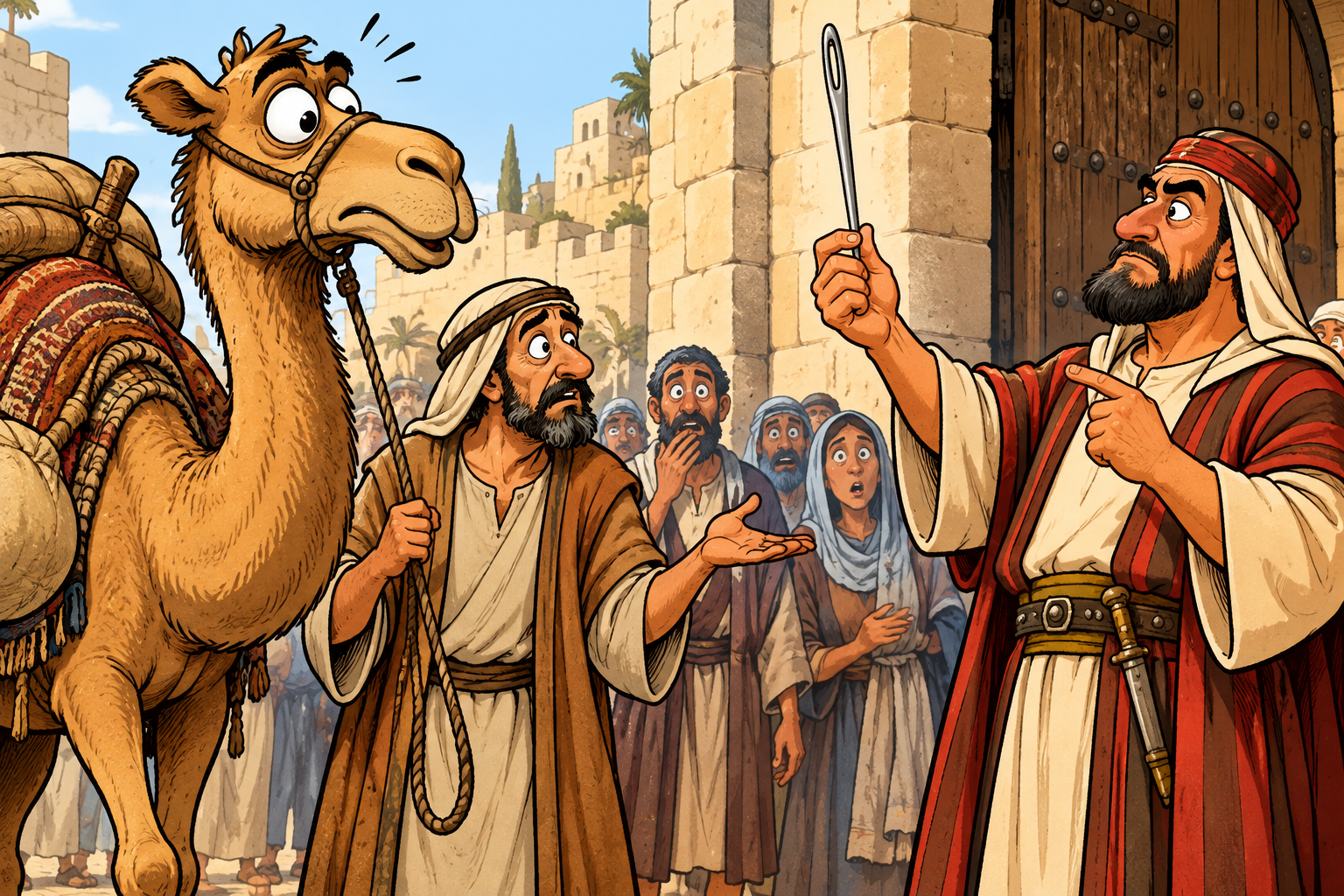
The idea that this was a small gate in Jerusalem has no good evidence, and it would spoil the point. The image is deliberately impossible and a little absurd.
When people cannot grasp something radical, Jesus does not soften it. He just makes the point visually ... graphically ... as He does here.
Well, the disciples follow up by asking the right question: “Then who can be saved?”
And Jesus answers with a universal and fundamental truth: “With man it is impossible, but not with God. For all things are possible with God.”
The security was never in what the man himself could do or own.
Entering the kingdom of God, inheriting eternal life, is not an achievement. It is a rescue.
That links back to Mark 10:15: whoever does not receive the kingdom like a child will never enter it ... but I digress.
Peter and the promise
Peter says, “We have left everything and followed you.”
Jesus does not scold him.
He promises a hundredfold, houses, brothers, sisters, mothers, children and lands, with persecutions, and in the age to come eternal life.
The man feared losing land, and Jesus lists lands.
The hundredfold is a family, the people of God, not a larger bank balance.
And the big point ... which gets made throughout this section of Mark's Gospel ... is that it comes with persecutions, because the security Jesus gives is belonging to Him and His people. Hardship is His own genuine experience, and those who follow Him will also find themselves right in the middle of it.
What this means
- Our security is the real subject. Money is only its most visible form.
- Good people are not exempt. The respectable may be most at risk of thinking they are fine.
- Entering the kingdom is a gift: impossible for us, possible for God.
- Following the crucified Messiah costs something real, because we cannot hold on to our own security and to Him at the same time.
- What we receive is better than what we leave: a family, a God who holds us, and a life that does not end.
The Upshot
The man ran up and walked away sad.
Mark will not tell us how his story ended, because he wants us to answer it for ourselves.
Picture this: Jesus is on the road. He looks at you, and He loves you. He asks what you are leaning on, and then He says what He said to the man and to Peter: come, follow me.
However we respond to that invitation ... that will be the upshot.
Questions for reflection
- What do you quietly say to yourself when you think “I’ll be alright”?
- Where might you be most tempted to trust in being respectable or reliable?
- What would it look like to hold what you have with open hands?
Watch the video:

Take Up Your Cross: What Mark 8:27-38 Says About Following Jesus as Messiah