Slow on the Uptake: Why Jesus Keeps Telling Us What We're Very Slow to Hear Mark 10:32-45

Mark 10:32-45: the third passion prediction, the request of James and John, and why Jesus says greatness is service and his life a ransom.
Have you ever said something to someone and watched it land in their ears but go no further?
In our house, that is a regular occurrence, and I am usually the one causing the problem!
All too often the words are heard, but the thing the words were meant to do does not happen.
The philosopher J. L. Austin had a name for it: a failure of uptake, and Mark 10:32-45 is a passage full of it.
WHAT THE WORDS ARE DOING
Austin pointed out that speaking is acting. A judge says “guilty” and a man is guilty. A farmer shakes a neighbour’s hand and says “done,” and the deal is done. Words do things.
So when Jesus, walking ahead of his frightened disciples on the climbing road from Jericho up to Jerusalem, says for the third time that he will be handed over, mocked, flogged and killed, and that after three days he will rise, what is he doing?

He is not predicting like a fortune teller.
He is telling them the truth, taking them into the story (“we are going up to Jerusalem”) and owning the very thing they really don't wan to hear. He owns that word “delivered over” (Mark 10:33 "the Son of Man will be delivered over to the chief priests and the teachers of the law") which echoes the suffering servant of Isaiah 53.
It is clearly something He embraces because it's meant to be. Jesus walks up that road with his eyes open.
And they still do not take it in.
THE BLANK CHEQUE
Straight after, James and John come with a request that is really a demand: “Teacher, we want you to do for us whatever we ask of you.”
They are not wicked men. They have heard the glory part and want the best of it. Jesus does not tear a strip off them. He asks, “What do you want me to do for you?”
Sometimes the only way to see what is in our heart is to hear ourselves say it aloud.
Then comes his assessment: “You do not know what you are asking.”
He tests them with two Old Testament pictures: v. 38 "‘Can you drink the cup I drink or be baptised with the baptism I am baptised with?’"
The cup is God’s cup of judgement (Psalm 75:8).
The baptism is being overwhelmed by waters (Psalm 69:1-2).
“We are able,” they say.
No doubt their words are sincerely meant. But like the people at Sinai who promised to do all the Lord said and were worshipping a calf within weeks, their aspiration is very clearly ... currently ... beyond.
Yet Jesus does not mock their promise.
He tells them God will do in them what they cannot do themselves. And where they couldn't He delivered. James was the first of the Twelve to die faithfully ... at the hands of Herod (Acts 12:2).
THE SEATING PLAN
“To sit at my right hand or at my left is not mine to grant.”
This is not a lack of authority. Mark has been showing us his authority since chapter 2.
It is how the Son works: he receives everything from the Father and gives it the Father’s way. The throne is not a prize for the loudest asker.

SERVICE COUNTS AS GREATNESS, AS GREATNESS SERVES
The other ten are indignant, which gives them away.
If they did not want the seats, they would not mind who asked.
It's getting tense soJesus calls them all together: the rulers of the Gentiles lord it over them, “but it shall not be so among you.”
Notice he does not condemn the wish to be great. He changes what it reaches for, and by which road: “Whoever would be great among you must be your servant.”
THE 'FOR EVEN' THAT CARRIES THE WEIGHT
Verse 45 begins with two small words: “For even.”
Jesus does not simply say “be servants.” He says, in effect, be servants because I have been one for you. “The Son of Man came not to be served but to serve, and to give his life as a ransom for many.” (Mark 10:45)

Daniel 7 pictures the Son of Man served by all nations. Here he serves the nations.
And as He does so, He pays their 'ransom'.
Now, a ransom is not a message about a price. It is the price.
And, very significantly, Psalm 49 says no one can ransom another, yet ends with the hope that God will ransom my soul from the power of Sheol. Mark 10:45 is that hope come true.
This is language you cannot hear from a safe distance. If someone gave his life as a ransom for you, you have either been ransomed or you have refused it.
WHAT DO YOU WANT?
A few verses on, Jesus asks Bartimaeus the same question as He put to James nd John: 'What do you want?'.
Bartimaeus does not want a seat. He wants to see. And when he sees, he follows Jesus on the road.
If Jesus asked you today, “What do you want me to do for you?”, what would you say?
FREQUENTLY ASKED QUESTIONS
Q: What does Mark 10:45 mean?
A: Mark 10:45 says Jesus came not to be served but to serve, and to give his life as a ransom for many. It means his greatness is shown in service, and that his death is the price paid to set people free, something no human could pay for another.
Q: What is the main message of Mark 10:32-45?
A: Jesus tells his disciples for the third time that he will be killed and rise again, two disciples ask for places of honour, and Jesus teaches that in his kingdom greatness is measured by service, because he himself came to serve and give his life as a ransom.
Q: Why did James and John ask to sit at Jesus’ right and left?
A: They had heard Jesus speak of coming glory and wanted the top positions in it. In the ancient world, the seats on a king’s right and left were the places of highest honour. Jesus did not shame the desire but told them they did not know what they were asking.
Q: What did Jesus mean by “the cup I drink” and “the baptism I am baptised with”?
A: Both are Old Testament pictures of suffering. The cup stands for God’s judgement (Psalm 75:8, Isaiah 51:17), and baptism stands for being overwhelmed by waters (Psalm 69:1-2). Jesus is asking whether they can follow him into suffering, and promises that they will.
Q: What is a ransom in the Bible?
A: A ransom is a price paid to buy back a life or free a captive (Exodus 21:30, Leviticus 25:47-49). In Mark 10:45 Jesus describes his death as that price, paid for many who could never pay it themselves (Psalm 49:7-9, 15).
Q: Why were the disciples slow on the uptake?
A: Jesus had told them three times he would suffer, be killed and rise (Mark 8:31, 9:31, 10:33-34), but they expected a conquering Messiah. They heard the words but did not take in what Jesus was doing with them.
Q: What does Jesus say true greatness is?
A: In Mark 10:43-44, Jesus says whoever wants to be great must be a servant, and whoever wants to be first must be slave of all. Service, not rank, counts as greatness in his kingdom.
KEY TAKEAWAYS (for description or schema summary)
- Jesus told his friends three times where the road leads, because he would not have anyone follow under false pretences.
- James and John spoke a request that was really a demand, and Jesus responded with a question, not a rebuke.
- In the kingdom of God, service counts as greatness.
- Mark 10:45 is a statement and a deed: the price was actually paid.
- The same question Jesus asked James and John, he asks Bartimaeus. One wanted a throne, the other wanted to see.
Watch the Word for the Week: Slow on the Uptake (Mark 10:32-45) here:
https://www.youtube.com/watch?v=Vf7MFqUD-7c
This is part of the Discovering Mark series ... subscribe and follow here for more.
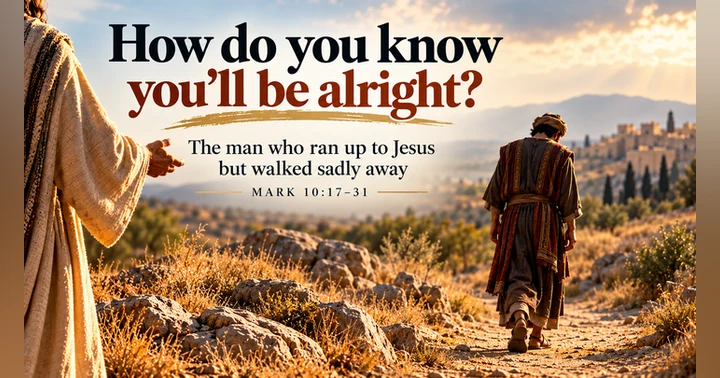
The Man Who Ran Up and Walked Away: Mark 10:17-31