Too Far Gone? The Centurion at the Cross (Mark 15:33–39)
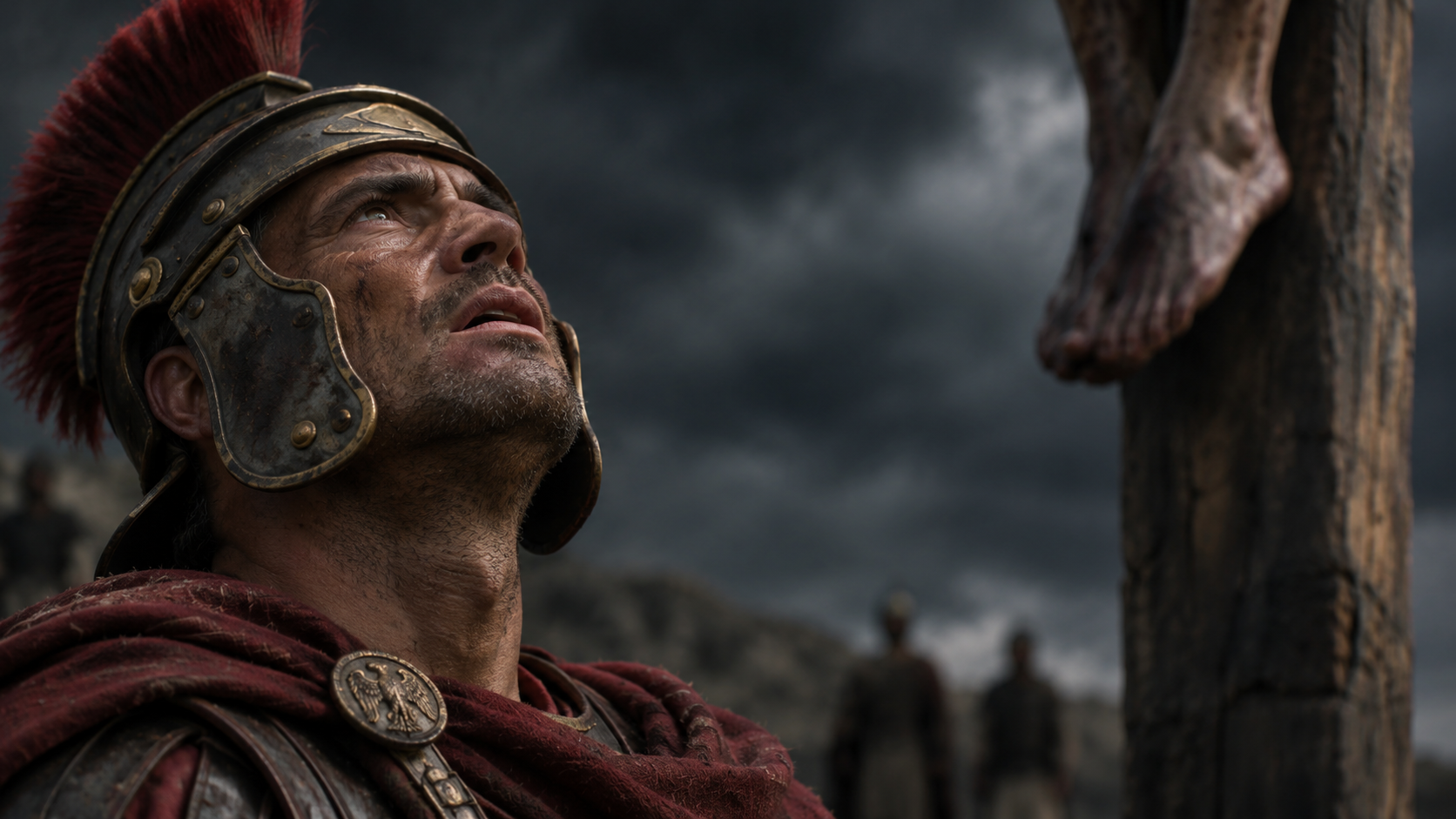
Who would you say is too far gone for God? Mark’s answer, at the climax of his Gospel, is startling. The first human being in his story to recognise Jesus as the Son of God is the Roman officer in charge of killing Him.
In seven verses, Mark gives us darkness at noon, a cry of abandonment, a cruel misunderstanding, a death cry, a torn curtain, and a confession: “Truly this man was the Son of God!” (Mark 15:39, ESV). This post walks through the passage and asks what it means for us.
The story so far
Mark opens with a headline: “The beginning of the gospel of Jesus Christ, the Son of God” (Mark 1:1, ESV).
Notice, that's two titles in total that Mark gives to Jesus: Christ (or 'Messiah') and the Son of God.
Now, we know who Jesus is from the first line ... where Mark TELLS us Who He is ... but most of the people in the story spend the whole of the period covered by Mark's Gospel trying to work it out, and for many the penny won’t fully drop until Pentecost.
Mark’s story moves in three stages:
- Galilee.
Jesus announces that the kingdom of God has come near (1:15), and shows what it looks like in healing, deliverance, forgiveness and welcome. People keep asking, “Who then is this?” (4:41, ESV). - The road to Jerusalem.
At the turning point, Peter confesses, “You are the Christ” (8:29, ESV). He’s right, but only half right, because he cannot accept a Christ who must suffer (8:31–33). Three times Jesus predicts His death, summing it up: the Son of Man came “to give his life as a ransom for many” (10:45, ESV). - Jerusalem.
Here Jesus, Messiah and Son of God, pours out His life to ransom the undeserving people who will become the people of God.
Our passage is the climax of the whole journey.
At the midpoint, a Jewish disciple confessed Jesus as Messiah.
At the cross, a Gentile soldier confesses Him as Son of God.
Both titles of 1:1 have now been spoken.
Remember how shocking hearing about all of this from Mark would have sounded to anyone hearing it for the first time.
Martin Hengel showed that crucifixion was regarded as the most shameful death imaginable (Hengel 1977).
Yet Mark makes the cross the very place where Jesus is recognised for who He is.
As Peter Bolt puts it, what Mark is doing here is to invite us to watch the cross “from a distance”, like the women nearby; but then when the executioner speaks, to see what the centurion saw (Bolt 2004).
Two movements
Mark tells the scene in two parallel movements, each with a sign from God, the voice of Jesus, and a human response:
- Movement one (vv. 33–36): darkness, the cry of abandonment, and the bystanders’ misunderstanding.
- Movement two (vv. 37–39): the death cry, the torn curtain, and the centurion’s confession.
The key lies in the responses. The bystanders say, “let us see” (v. 36, ESV). The centurion “saw” (v. 39, ESV). Mark is showing us two ways of watching the cross.
What crucifixion meant
Crucifixion was Rome’s punishment for slaves, violent criminals and rebels.
Cicero called it the cruellest and most hideous of punishments (In Verrem 2.5.165).
The people of Judea knew about it all too well: Varus crucified two thousand rebels, and Titus crucified up to five hundred a day during the siege of Jerusalem in AD 70 (Josephus, Jewish War 2.75; 5.449–451).
Prisoners headig to crucifixion were flogged, made to carry the crossbeam, stripped, and nailed to the cross.
The bones of a crucified man found in Jerusalem in 1968 still had an iron nail through the heel (Zias and Sekeles 1985). It was brutal and victims could hang for not just hours but for days.
But Jesus's crucifixion would look different from 'normal'.
Darkness at noon (v. 33)
“There was darkness over the whole land until the ninth hour” (v. 33, ESV): from noon until three.
It's important to recognise this was no natural phenomenon ... specifically it couldn’t have been an eclipse, because Passover always fell at full moon (Brown 1994).
Significantly though, Mark’s Jewish readers would hear the echo of Amos 8:9–10, where the prophet (speaking for God) predicts “the sun will go down at noon” and describes as “like the mourning for an only son” (ESV).
You can join the dots there quite easily, no doubt! Jesus is God’s “beloved Son” (1:11). So here Creation mourns as the Creator's only Son dies (Hooker 1991).
There are further echoes from God's previous judgemet on sin ... darkness also recalls the plague before the first Passover (Exodus 10:22) ... and Jesus’ words about the sun being darkened in Mark 13:24 also seems very relevent.
This is a day of judgement, but it is judgement Jesus is bearing there for those who will become His New Covenant people.
“My God, my God, why?” (v. 34)
Jesus’ last words in Mark are a question, from Psalm 22:1. Mark keeps the Aramaic, Eloi, Eloi, lema sabachthani, and translates it for his Roman readers, so we can get as close as possible to hearing Jesus’ own voice.
Significantly, this is the only prayer in Mark where Jesus doesn’t call God “Father”.
In Gethsemane it was “Abba, Father” (14:36).
Now it is “My God”.
What's going on here is that as the sins of His people are laid on Him, the Lord bears Himself the abandonment they deserved ... and does so as their substitute. Mark doesn’t soften the horror of it (France 2002). Yet in spite of it all, Jesus still prays “my God”, as He faithfully prays this psalm..
Well, Psalm 22 moves from desolation to vindication, ending with “all the families of the nations” worshipping the Lord (Psalm 22:27, ESV). Quoting its first line brings the whole psalm to mind (Hays 2016) which after its darkness, ends very positively ... just keep those nations in view1
“Let us see whether Elijah will come” (vv. 35–36)
Some of the people in the crowd around the Cross seem to have heard “Eloi” as “Elijah”, who was popularly expected to rescue the righteous (Brown 1994). But Mark’s readers know Elijah had already come, in John the Baptist (9:11–13).
Someone offered Jesus sour wine, probably posca, the soldiers’ cheap drink (Brown 1994), recalling Psalm 69:21.
Then come the telling words: “let us see”.
The chief priests had already jeered, “Let the Christ … come down now from the cross that we may see and believe” (15:32, ESV).
These watchers want a Messiah who escapes the cross.
But He won’t.
And that's the point.
The death cry (v. 37)
“And Jesus uttered a loud cry and breathed his last” (v. 37, ESV).
Crucified men usually died slowly, too exhausted to speak (Cook 2014). Jesus died after about six hours, surprising Pilate (15:44), but with a shout not a whimper ... and even in death, He is the one Who seems to be taking the initiative. His life isn’t taken; He gives it (Gundry 1993).
The torn curtain (v. 38)
“And the curtain of the temple was torn in two, from top to bottom” (v. 38, ESV).
Although they couldn't see it, it was clearly established in the minds of all the people around that cross that the curtain marked the boundary of God’s holy presence (Exodus 26:31–33).
Three details matter:
- From top to bottom. No human hand reached that high. God did this.
- Torn. Mark uses this word only here and at the baptism, where the heavens were “torn open” (1:10, ESV). Heaven opened at the start; the way to God opens at the end.
- Temple. Mark uses the word for the sanctuary itself, the same word as in the charge that Jesus would destroy the temple (14:58; 15:29). God answers the mockers.

The torn curtain signals both judgement on the old temple (13:2) and open access to God through Jesus’ death (Hooker 1991; Marcus 2009). The centurion couldn’t have seen it. Mark tells us, so that we can.
The centurion (v. 39)
Judea’s troops were auxiliaries, mostly from non-Jewish cities such as Caesarea and Sebaste (Josephus, Antiquities 19.365). So this centurion was almost certainly a Gentile, the commander of the execution squad, and very likely one of the cohort that had mocked Jesus with purple and thorns (15:16–20).
And the centurion ... responsible for ensuring the job was done ... “stood facing him” (v. 39, ESV).
He had overseen many crucifixions, and what he saw in Jesus was absolutely not how crucified men died.
This knarled old soldier ... by the time you became a centurion you'd seen a lot of action ... “saw that in this way he breathed his last”, and then spoke.
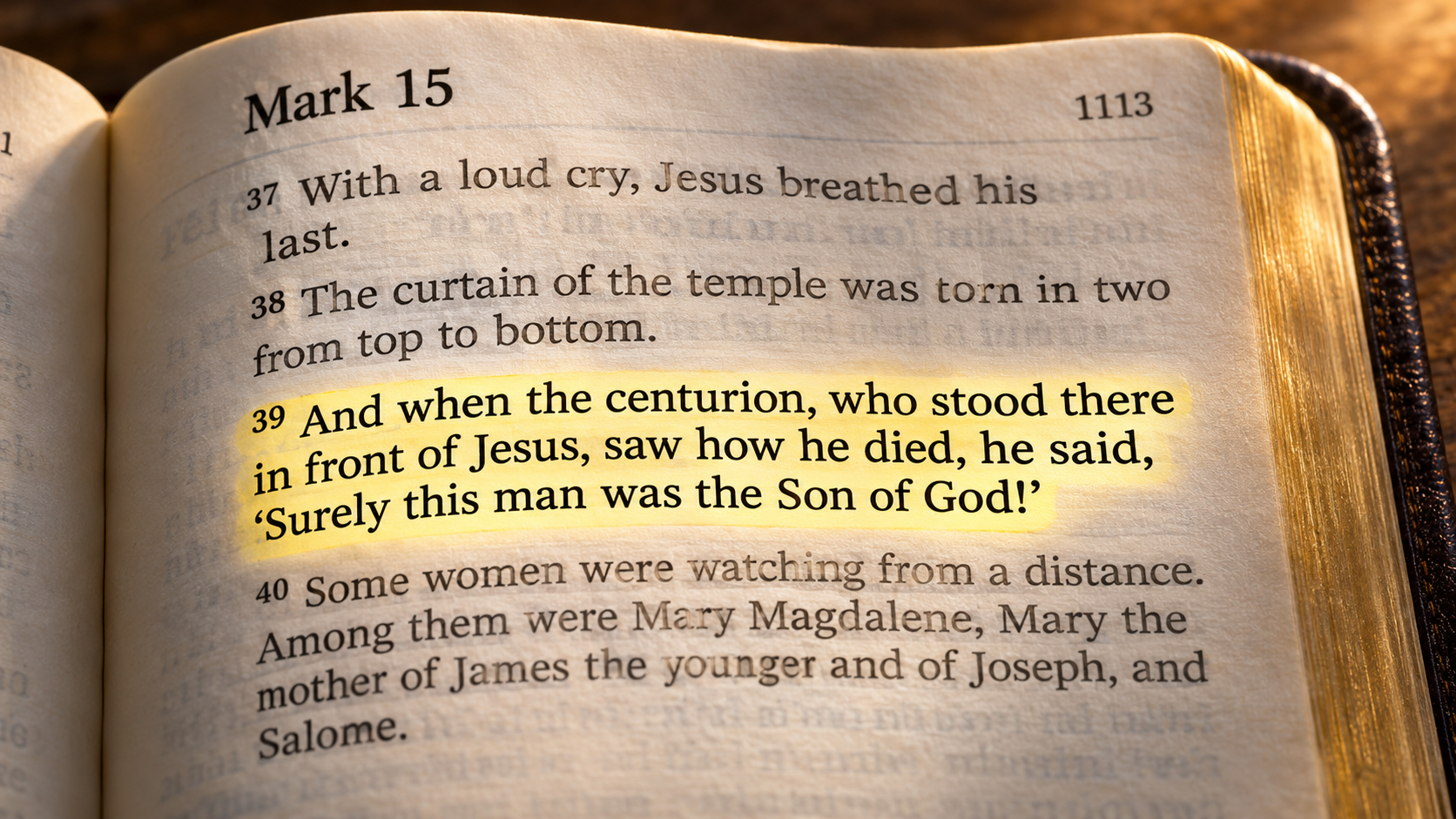
His first word, in Greek, is “truly”.
Earlier, a bystander had said to Peter, “Certainly (it's the same word in both places) you are one of them,” and Peter denied Jesus (14:70).
In a Gospel that probably owes much to Peter’s own testimony, the irony is striking: Peter the disciple denied truly; the executioner confesses truly (Edwards 2002). It's quite something for Mark to have heard and then written.
What did he mean?
Some scholars think the centurion meant only “a son of a god”, a hero (Johnson 1987).
Others read a full confession (Gundry 1993; France 2002). The wider context of Mark's Gospel supports this view as in Mark 1:1 Jesus was the described as the unique Son.
But there’s another layer.
In Roman politics, it was the emperor who was hailed as “son of god”.
So now when one of Caesar’s own officers, at an execution for treason against Caesar, gives that title to a crucified Jew, Mark’s first readers would hear a startling counter-claim: there is another King, and another Son (Kim, T.H. 1998; Peppard 2011), and the true Son is the One on that Cross.
Whatever the centurion grasped, Mark makes sure we hear the full truth. The words 'the Son of God' echo God’s voice when the Heavens open at the Lord's baptism ... and also Mark’s opening line.
Why at the cross?
Throughout Mark, Jesus tells people to keep quiet about who He is (1:34; 8:30; 9:9). Here’s why: you can’t understand who Jesus is until you see Him crucified.
The mockers wanted a Son of God who would come down.
The centurion saw a Son of God who stayed (Bolt 2004).
And it’s fitting that an outsider speaks first.
Psalm 22 ends with the nations turning to the Lord. Jesus said the gospel must go to all nations (13:10). The curtain is torn, and the first person through the door is a pagan soldier.
The King on the cross
Mark 15 is full of kingship: “King of the Jews” five times, “King of Israel” once.
In it Jesus is robed, crowned, saluted and lifted up under a placard naming His title, with one man at His right and one at His left (cf. 10:37).
Interestingly, Thomas Schmidt has shown how Mark echoes a Roman triumphal procession (Schmidt 1995) ... and that's certainly worth Googling to see what you thinki of that ... but it's plain as day surely to all of us that every mockery thrown at Jesus here has been telling the truth about Him that's being so widely rejecting.
In spite of everything thrown at Him, the cross is where the King takes up His throne.
Fall all his insight, the centurion's not yet an accomplished theologian ... he has lots more to learn ... and yet the centurion says Jesus “was the Son of God”, over what all of his training said was now a dead man.
But Mark hasn’t quite finished his Gospel yet.
Joseph of Arimathea, a man “looking for the kingdom of God” (15:43, ESV), takes and buries the body of Jesus, then on the third day the women hear, “He has risen” (16:6, ESV).
Here are the key take aways for us:
- The cross shows us who Jesus is. He is most clearly the Son of God in His death.
- No-one with a pulse is ever 'too far gone' for Jesus.
The man in charge of killing Jesus was the first to recognise Him. and that must mean neither you or I can be beyond salvation's reach. - The way is open to us.
God himself intervened and tore down the curtain of division from Himself.
We don’t climb up to Him. That's not the gospel. It's He Who has opened the way for us, to Himself. - We must decide how we will watch.
Some said, “Come down, and we will believe.”
One man saw Jesus stay, and when he saw how Jesus died His killer believed.
So ... as you gaze at the Lord's Cross this week, it's important to ask yourself Who (or just who) you see there.
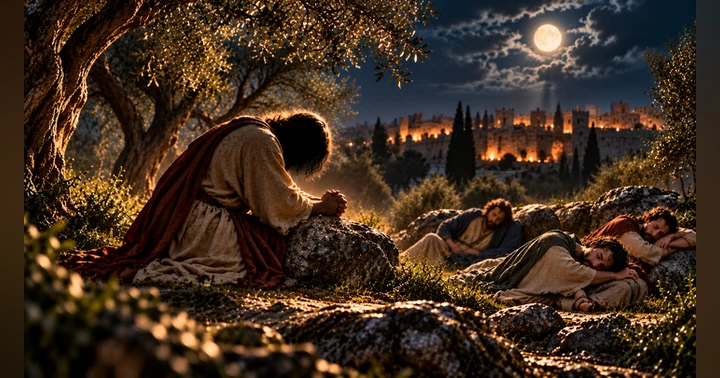
What Does Gethsemane Teach Us About Following a Crucified Messiah? Mark 14:32-42