The Song Heaven Is Already Singing: Nationalism, Wales, and Revelation 5:9

There is a song being sung right now that you cannot hear.
It is being sung by creatures you have never seen, by elders you have never met, by a vast choir drawn from every people who has ever walked this earth. It is addressed to a Lamb who was killed and is, impossibly, alive. And it is being sung in heaven, where the world is actually governed from, while a tractor goes past and the milking parlour hums and the Welsh hills carry on looking exactly as they always have.
This week's Word for the Week, filmed at Cadfan Farm in Carmarthenshire (the name means "front lines of the battle," close to the site of the 13th-century Battle of Llandeilo Fawr), works through Revelation 5:9 and asks a question that Welsh churches need to sit with carefully: is love of your nation something to repent of? And where does it become something you should?
WHAT THE TEXT ACTUALLY SAYS
Revelation 5:9 records the new song of the four living creatures and the twenty-four elders when the Lamb takes the scroll:
"Worthy are you to take the scroll and to open its seals, for you were slain and by your blood you ransomed people for God from every tribe and language and people and nation."
The key word is the small Greek preposition ek, translated "from." In this context, with this grammar, it is doing something technically precise. Greek grammarians call it the partitive use of ek: a subset drawn from within a larger whole, without obliterating the larger whole. The Lamb has not redeemed every single person from every tribe. He has redeemed people from within every tribe, people who are still members of those tribes, who still carry those languages and stories and identities with them, even as they now belong to the community of the redeemed.
This is not a minor grammatical footnote. It determines whether the vision of heaven in Revelation is a picture of universal salvation with no need for conversion, or a picture of particular redemption drawing people out of every culture to follow the Lamb. The text is clear. People need to turn to Christ. But those who do retain their human particularity. The Lamb does not homogenize before he redeems.
THE BIBLICAL TRAJECTORY
This is not a New Testament surprise. The trajectory runs deep through the Old Testament:
Genesis 12: God calls Abraham and promises that through his offspring all the families of the earth will be blessed. Not just Israel. All families.
Psalm 87: One of the most overlooked psalms in Scripture. Egypt, Babylon, Philistia, Tyre and Kush are enrolled in Zion's register, named as born in the city of God. Their identity is not erased. They are gathered as themselves.
Isaiah 49: God says to his Servant (whom the New Testament identifies as Jesus) that it is too small a thing to restore only the tribes of Israel. The goal is bigger.
Isaiah 56: Foreigners who bind themselves to the Lord are brought to the holy mountain. The house of prayer is to be for all nations.
Acts 2 at Pentecost is astonishing on this point. The Spirit does not create a single new shared language. Each person hears in their own tongue and dialect. The confusion of Babel is not reversed by producing uniformity. It is reversed by the Spirit speaking through every tongue simultaneously.
And Revelation 22 brings the whole arc to its conclusion: the nations walk by the light of the New Jerusalem, and the kings of the earth bring their glory into it. The nations are still there in the new creation. They are still bringing something distinctively their own.
THE LINE BETWEEN GOOD PATRIOTISM AND IDOLATRY
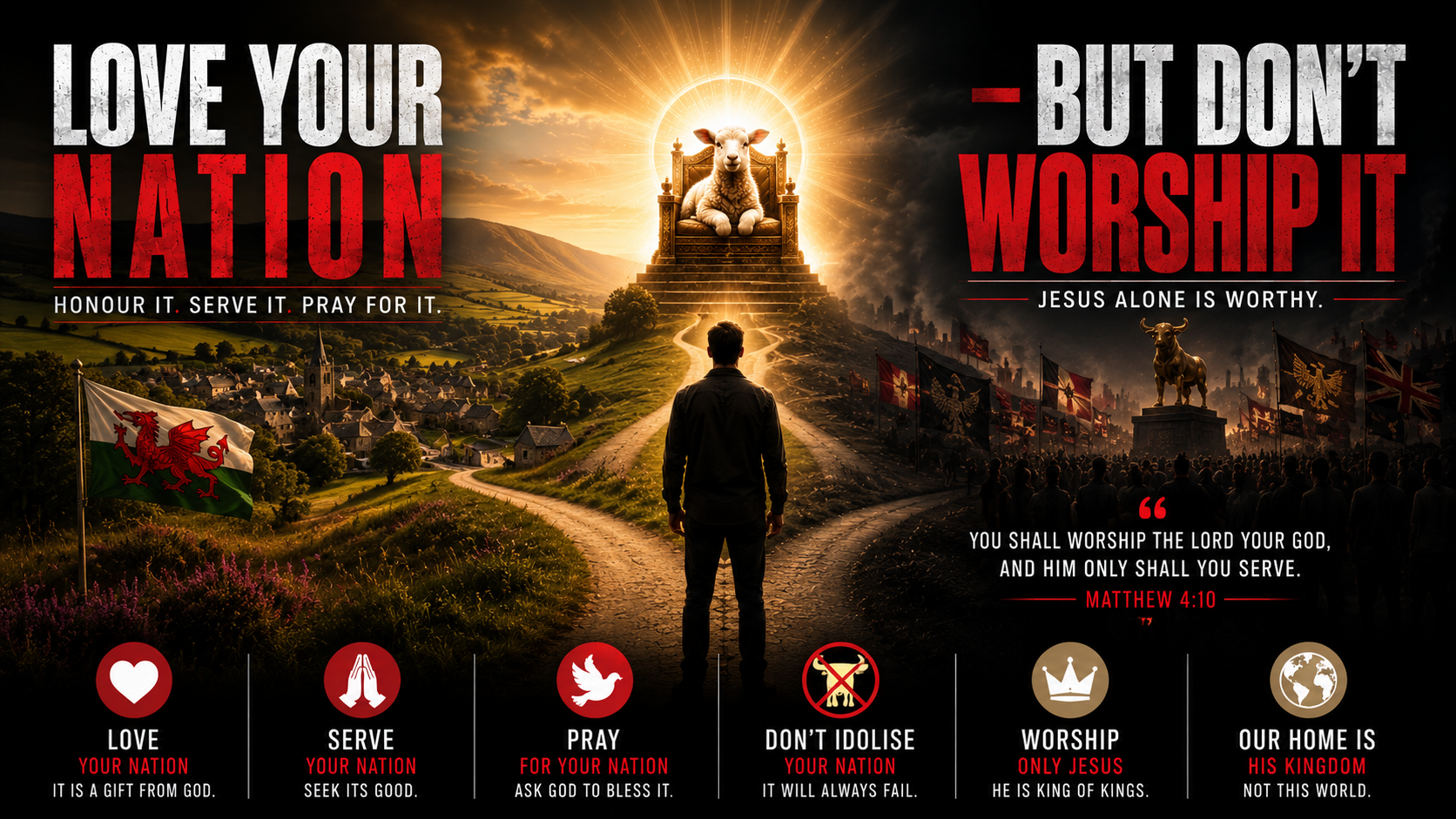
Scripture endorses cherishing your own people. Jesus weeps over Jerusalem. Paul could wish himself cut off from Christ for the sake of his fellow Jewish people. Nehemiah weeps over the broken walls of his city. This passionate solidarity with a particular people, a particular land, a particular cultural inheritance, is not condemned in Scripture. The love of your own language, your own history, your own way of being in the world, is a recognisable and legitimate good.
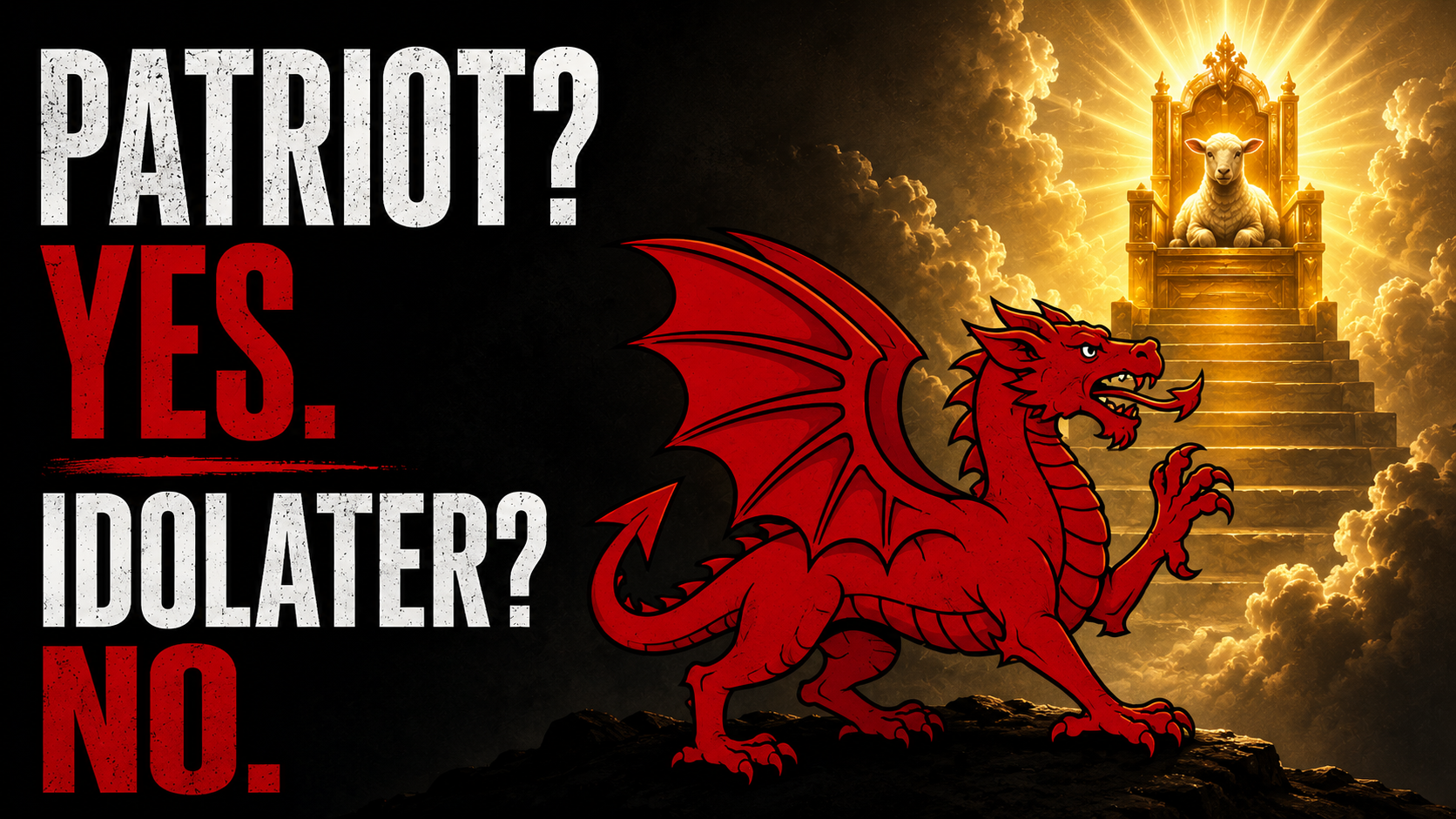
But the Bible rules out the sacralization of any particular national identity. When the preservation of your nation becomes a religious duty that overrides other obligations, when Christian identity and national identity become so fused that to be truly Welsh (or truly English, or truly anything) you must hold a particular faith, that is idolatry. The ek of Revelation 5:9 makes this structurally impossible. No single nation is named in that great fourfold formula. Each is simply one instance of a universal category. The Lamb's purchase reaches equally into all of them.
WALES, NATION OF SANCTUARY, AND HONEST WELCOME
Simon draws on Zakia Sywell's new book Finding Albion (2026), which argues that English patriotism tends to be expressed through the institutions and exercise of power, while Welsh patriotism, in its most characteristic expressions, has grown from the experience of being the smaller and the overlooked. It is a nationalism of the hearth rather than the sword.
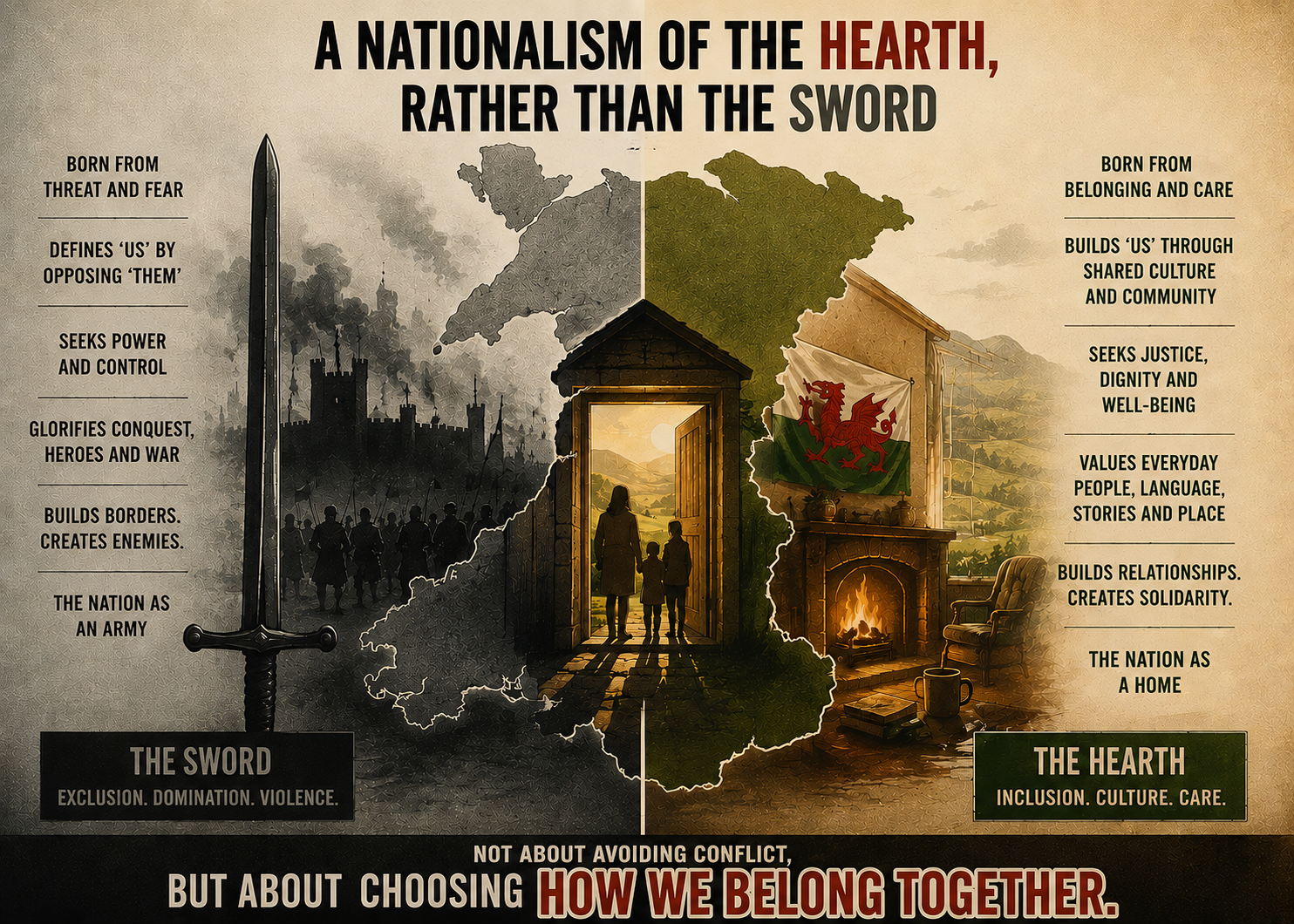
Wales has declared itself a Nation of Sanctuary. The impulse, rooted in Wales's welcome of Italian and Polish communities around the Second World War, that says our own experience of marginalization should make us more rather than less open to the marginalized, resonates deeply with the biblical logic of Revelation 5:9.
But good instincts can face real complications, and those complications need to be named honestly. Welcome without discernment is not serving guests or host community well. The vision of Revelation 5:9 is not that every nation comes in wholesale, bringing its values unchanged. It is that people are drawn out from every nation, which implies that some things are left behind. The norms of the community of the redeemed are set by the Lamb, not by any particular cultural heritage, whether Welsh or otherwise.
THE QUESTION FOR WALES
Can we love our nation, cherish our language and history and distinctive way of being in the world, open our arms to the stranger, be a genuine Nation of Sanctuary, and do all of that in a way that makes us more like the Lamb rather than less? Does our love for our people open our hands in generosity, or close our fists around something we are determined to preserve at any cost?
The Lamb's hands were not closed. They were opened by nails. From that posture of absolute vulnerability and absolute love, he purchased people coming to him from every tribe, every tongue, every people, every nation, remaining that people, tribe, tongue and nation all the while.
That is the song heaven is already singing. The question for Wales is whether we are learning the words.
QUIZ: How Well Did You Follow this Blog?
- What does the partitive use of ek tell us about the scope of the Lamb's redemption in Revelation 5:9?
a) Every person from every nation is automatically saved
b) A subset from within every nation is redeemed, while national identities remain
c) National identities are abolished when people enter the kingdom
d) Only Israel is ultimately redeemed - Which psalm names Egypt, Babylon, Philistia, Tyre and Kush as born in the city of God?
a) Psalm 22
b) Psalm 72
c) Psalm 87
d) Psalm 46 - What does Acts 2 at Pentecost demonstrate about the Spirit's work and human language?
a) The Spirit replaces all languages with a single holy tongue
b) The Spirit works through and honours the diversity of human languages
c) The gift of tongues was a temporary sign that ceased after the apostolic age
d) The Spirit reversed Babel by restoring the original language of Eden - At what point does love of nation become idolatry, according to this teaching?
a) When you vote for a nationalist political party
b) When you prefer your own culture to others in everyday life
c) When national preservation becomes a religious duty that overrides other obligations
d) When you speak a minority language - How does Simon characterise the instinct behind Wales's Nation of Sanctuary declaration?
a) As something Welsh Christians should repent of
b) As naive and biblically unsupported
c) As resonating deeply with the logic of the Lamb, while needing honest discernment
d) As an exclusively political rather than a theological matter
Answers: 1-b, 2-c, 3-b, 4-c, 5-c
FREE GOSPEL OF MARK
If this blog has raised questions about who Jesus actually is, you will find that this completely free copy of Mark's Gospel in modern English really helps.
Mark is the fastest and most direct introduction to Jesus that exists. Follow the link below to get your copy, no cost and no obligation.
Rock, Empire and the Question That Changed Everything - Mark 8:27-38