Rock, Empire and the Question That Changed Everything - Mark 8:27-38
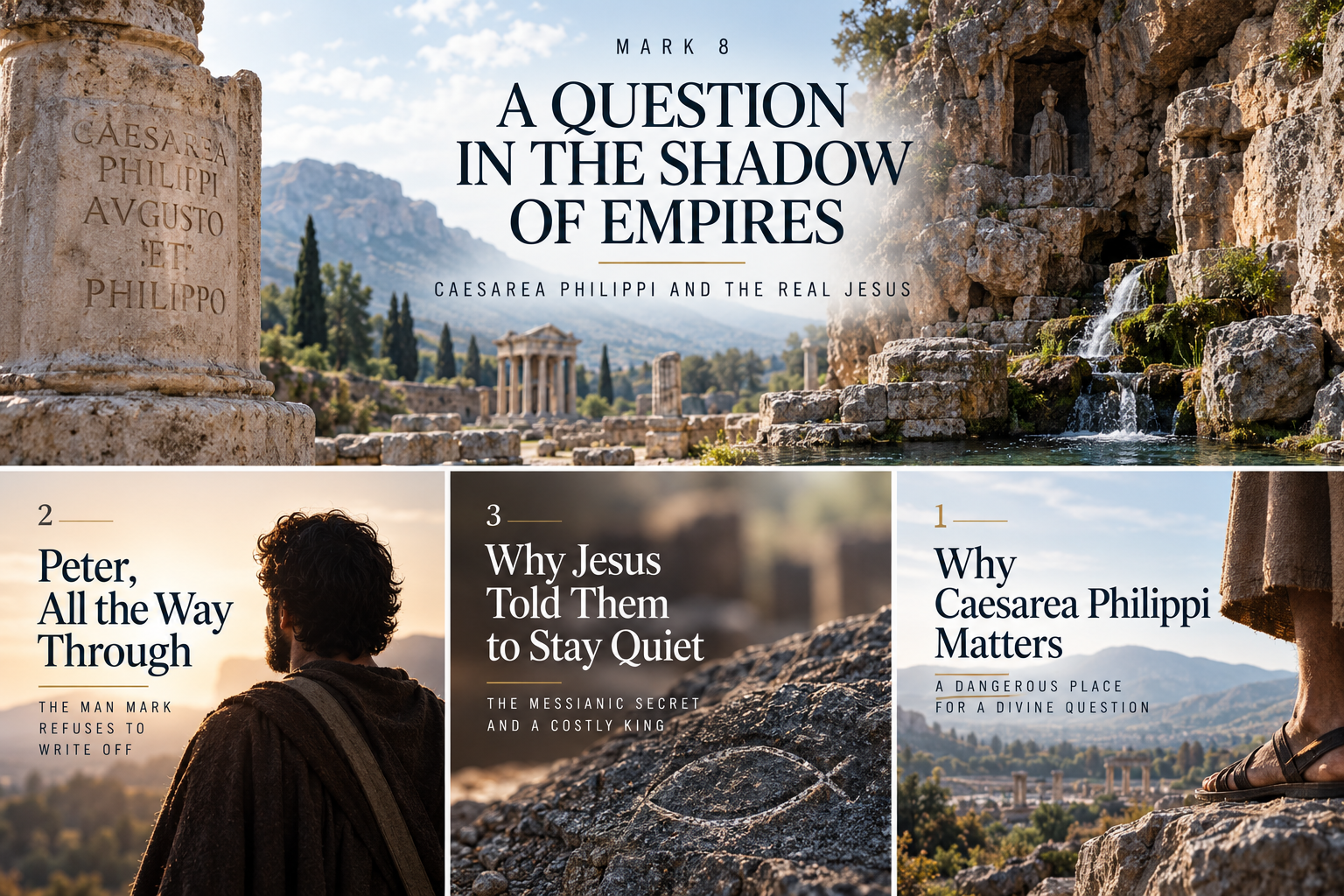
Why Caesarea Philippi Matters
As the episode coming out this week makes clear, Jesus asks his biggest question of the Gospel so far in a place that seems, at first glance, a strange choice.
Not the Temple courts.
Not a synagogue.
Not even plain old ordinary Galilee.
He asks it at Caesarea Philippi, and the location is really relevant to understanding the story ... so it's probably worth pulling apart a bit here.
Caesarea Philippi,was Herodian territory, but not Herod Antipas's patch, the Galilee-and-Perea tetrarch familiar to us from elsewhere in Mark's Gospel.
This was the territory of his half-brother, Philip, who had inherited the northern reaches of their father's kingdom and built himself a capital city there, renaming an existing settlement in honour of the emperor Augustus, and of himself (Caesarea Philippi, "Philip's Caesarea,") to set it apart from the larger, coastal Caesarea (Caesarea Maritima) further south by the seaside.
But this place had a history well before Philip got to it.
Long known as Paneas, it sat at a dramatic spring, one of the sources of the Jordan, beneath a rock face, and that spring had for centuries been associated with the Greek god Pan, complete with a shrine cut directly into the cliff.
Herod the Great, Philip's father, had already added a temple deciated to Augustus there decades earlier, before Philip's building projects extended it further.
By the time Jesus arrived with his disciples, this was a landscape layered with pagan cultic worship and Roman imperial religion, all layered up on top of each other ... in stone.
It was in THAT setting that Jesus asked His disciples who people were saying he was, and then who they would say He is.
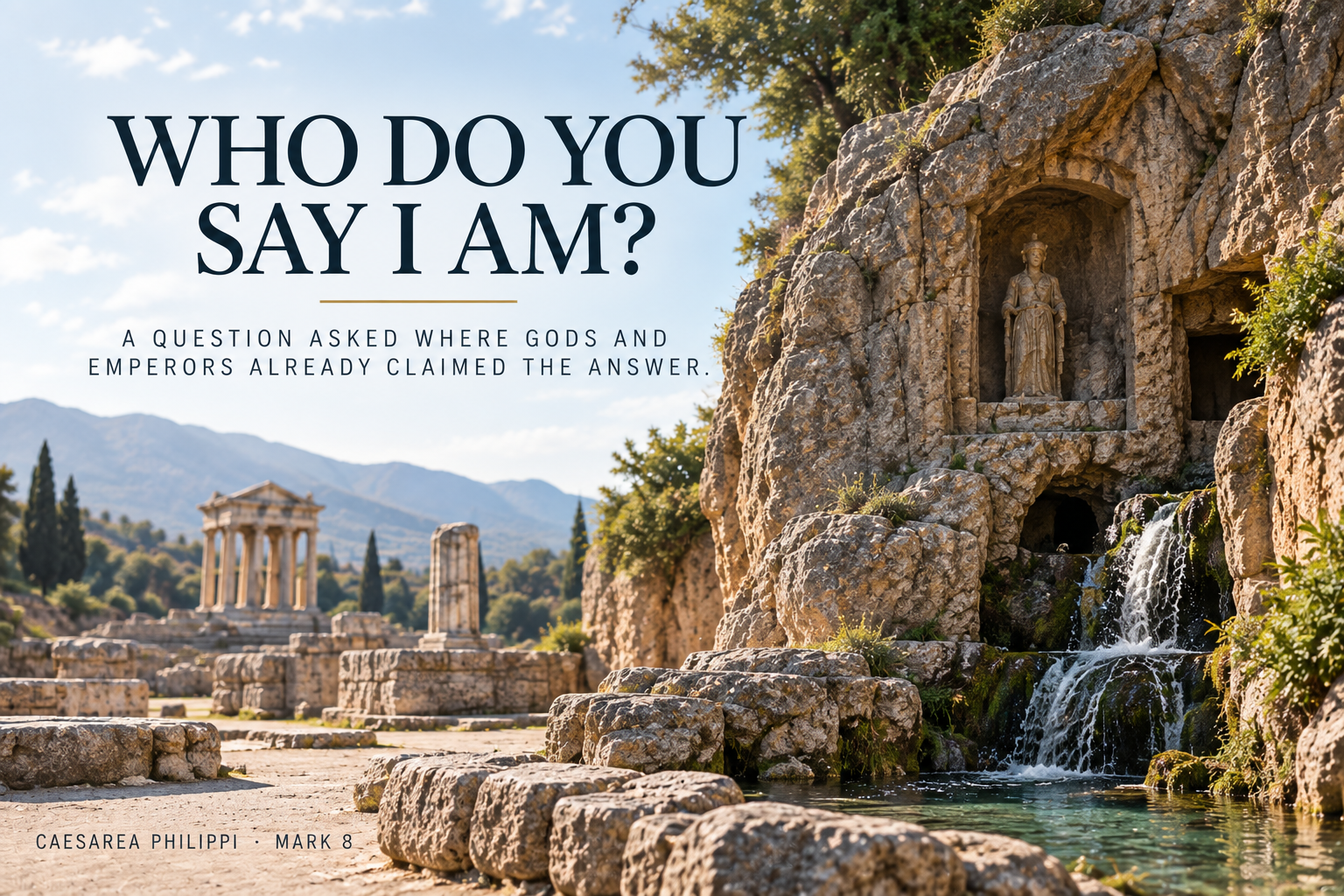
So you can see Peter's answer, "You are the Christ," isn't spoken in a religiously or politically neutral place.
It's spoken somewhere already saturated with claims to divine and imperial authority, a place built, quite literally, to honour Caesar and a god of the wild places. What Peter is doing is to confess a rival king to Caesar, in the backyard of an empire that already had its own fixed position on who deserved to be worshipped.
Mark doesn't explain the significance of the location, he simply names it and trusts an attentive listener to notice what he's doing.
Geography, in this passage, is carrying a heavy burden of theological work.
2. Peter, All the Way Through
If you want a single thread to pull on across the rest of Mark's Gospel, Peter's arc from this scene onward is one of the richest.
It begins here, at the rebuke Peter receives.
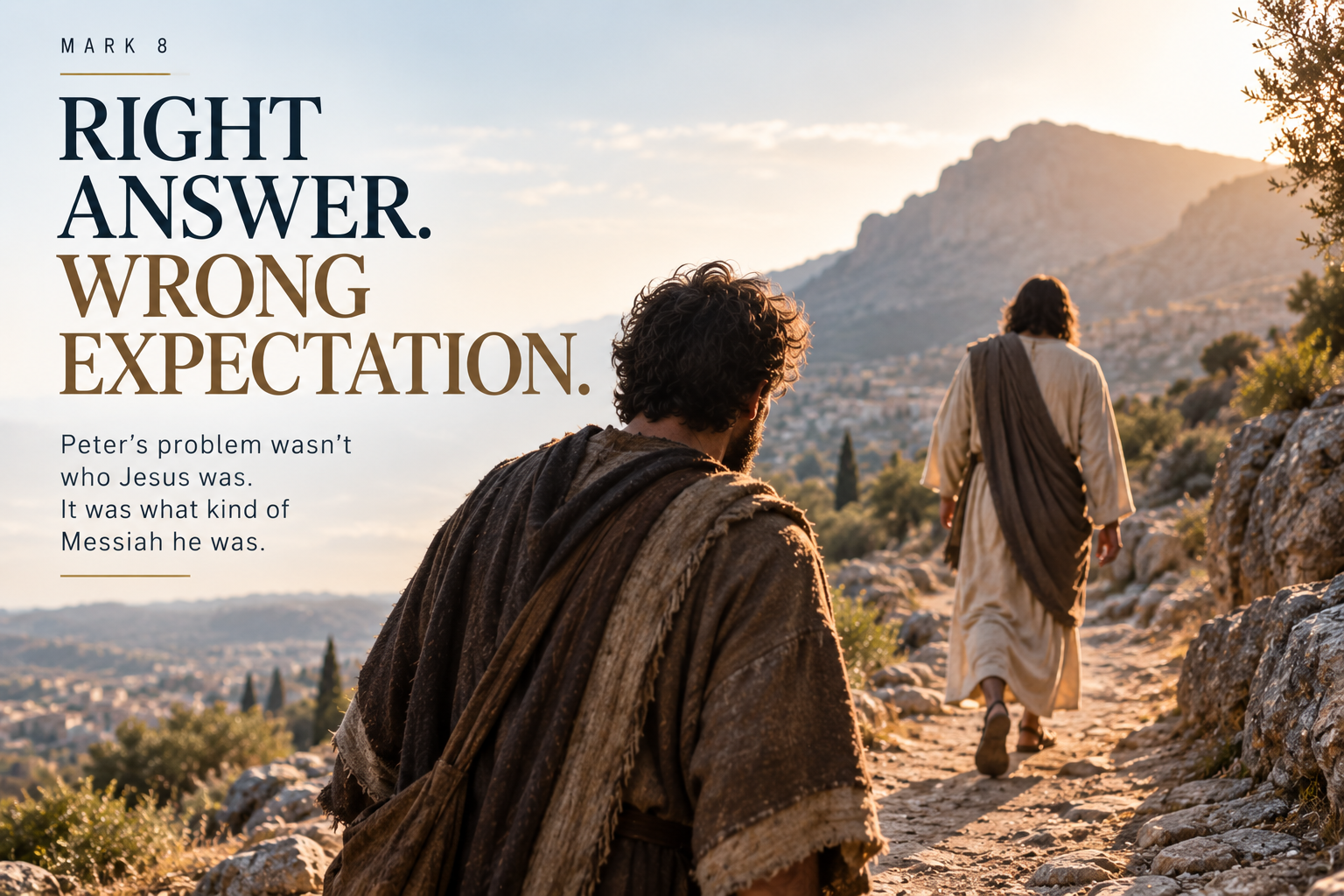
Peter says the right words, "You are the Christ," and then can't cope with what Jesus says those words actually mean.
So Peter takes Jesus aside and rebukes him for talking about suffering and death.
Jesus turns the rebuke straight back onto Peter in no uncertain terms: "Get behind me, Satan," ... using the exact phrase for following on behind Himself that He'd used to call Peter into discipleship in the first place.
Right answer Peter ... catastrophic misunderstanding of its real meaning.
Six days later, Peter is one of only three disciples taken up the mountain for the transfiguration (9:2-8). He sees Jesus's appearance transformed, dazzling white, talking with Moses and Elijah, and his response is to suggest building three shelters, one for each of them, an offer Mark tells us plainly came from not knowing what to say, because he and the others were terrified.
Peter is present for genuine glory now, a preview of the Son of Man "coming in his Father's glory" that Jesus had spoken of just six days earlier at Caesarea Philippi ... but Peter still doesn't quite know how to receive it.
Not long after, the disciples, Peter presumably among them, are caught arguing on the road about which of them is the greatest (9:33-37). Jesus has to sit them down and teach, again, that the first must be last and servant of all, taking a child into his arms to make the point.
The lesson of Caesarea Philippi, that Jesus's kind of greatness runs through suffering and self-giving rather than status, still hasn't sunk in.
And then, finally, the denial.
Three times, in the high priest's courtyard, Peter denies knowing Jesus (14:66-72).
Mark uses the verb ἀπαρνέομαι, "to deny," the identical verb Jesus had used back at Caesarea Philippi when he told the crowd that whoever wants to follow him must "deny himself" (ἀπαρνησάσθω ἑαυτόν, 8:34).
The sighnificance of that is that the word Jesus used to describe faithful discipleship becomes, three times over, the word Mark uses to describe Peter's collapse.
The extreme irony is that, told to deny himself ... Peter instead denies Jesus.
It's a bleak arc to trace, but not a hopeless one, since Mark's Gospel doesn't end with Peter in the courtyard.
The empty tomb message in 16:7 singles him out by name, "go, tell his disciples and Peter," a small, deliberate detail suggesting restoration is still on the table even after the worst failure.
It might be worth remembering that the man who couldn't hold the weight of Caesarea Philippi is the same man Mark's Gospel refuses to write off.
3. Why Jesus Told Them to Stay Quiet
One detail listeners sometimes ask about after reading this episode is this: why does Jesus respond to a correct confession, "You are the Christ," by telling the disciples to tell no one (8:30)?
Isn't that exactly the news you'd want spread?!
This is what scholars call The Messianic Secret, a pattern that runs right through Mark's Gospel, not just this passage. Here's how it shows up.
Jesus repeatedly:
- silences demons who correctly identify him (1:25, 1:34, 3:11-12),
- tells people he's healed not to publicise it (1:44, 5:43, 7:36), and
- here does the same with his own disciples' correct confession.
The pattern was named and studied in detail by the German scholar William Wrede back in 1901, and it's occupied New Testament scholars ever since.
The simplest and most widely held explanation, and the one this passage itself seems to support, is that the title was true but dangerously easy to misunderstand.
"Christ" carried enormous freight in first-century Jewish expectation, and much of that freight pointed toward a conquering, liberating king who would overthrow Rome.
If word spread that Jesus was "the Christ" before anyone understood what kind of Christ he actually was, suffering, rejected, crucified, then risen, the news would spread the wrong story entirely.
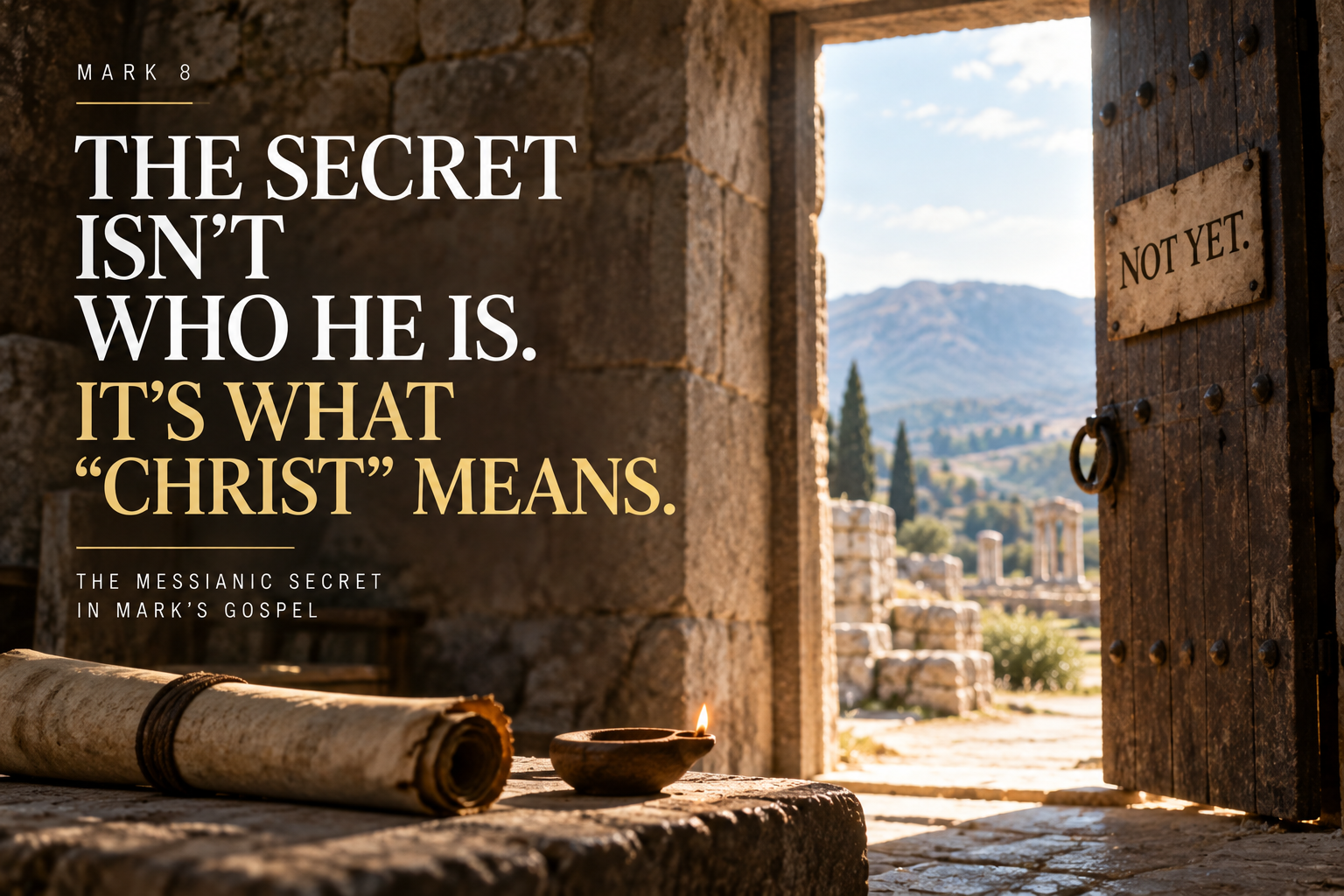
You can see this play out immediately in the text, because after this turning point in Mark's Gospel the very next thing Jesus does after silencing them is start teaching them what "Christ" actually means ... as if the silence about the Lord's identity is created to buy time for the redefinition.
There's a second layer worth a mention too.
Mark's Gospel as a whole seems to suggest that Jesus's identity can't really be understood correctly until it's seen through the cross.
Even the demons, who get the facts right, don't get the meaning right, they know Jesus is powerful without understanding that his power will be displayed through weakness and death.
So The Messianic Secret isn't Jesus hiding who He is.
It's Jesus insisting that who He is can only rightly be proclaimed once people understand what it costs ... what it costs both him and them ... which is exactly the lesson the rest of Mark 8:27-38 carries on to teach.
The Man Who Ran Up and Walked Away: Mark 10:17-31