The Day Jesus Answered the Biggest Question in the RoomMark 2:1-12 | Word for the Week Companion Post
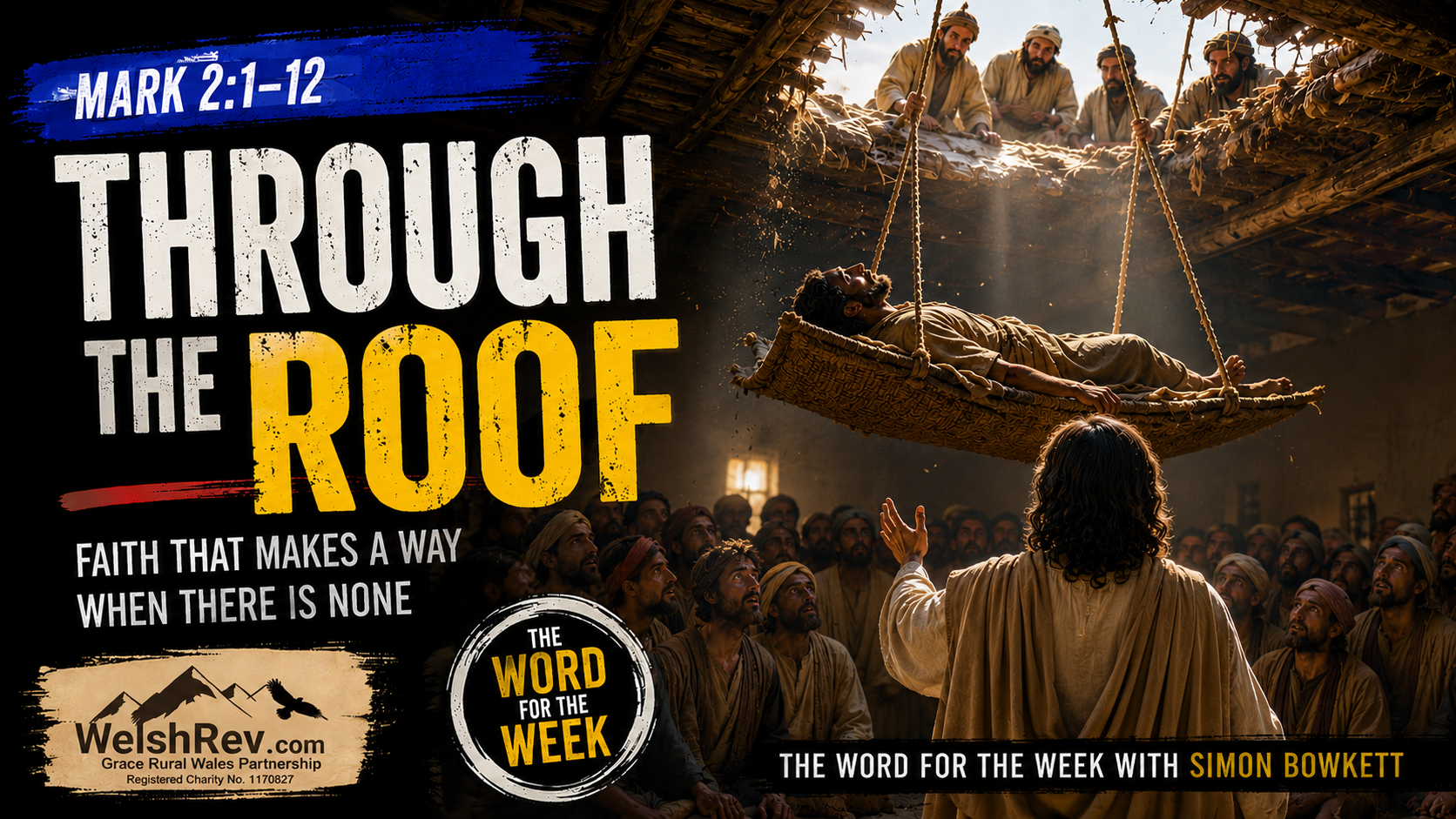
If you're going to challenge somebody with the question "who do you think you are?", you'd better make sure it's not the person Mark has just introduced as Jesus Christ, the Son of God.
That would be a red flag.
You'd be punching WAY above your weight!
But that's where the top notch religious experts started to go in Mark 2:1-12 with Jesus.
This passage is, at its heart, about identity and authority. Whose word can be trusted? Who has the right to say what Jesus says in the middle of this crowded Galilean house? And what happens when the supporting evidence arrives in a form nobody can argue with?
The Scene
Jesus is back in Capernaum. Word has spread that he is at home, most likely in the house of Simon and Andrew that we first encountered in chapter 1 verse 29. The house is packed. There is no room even by the door.
Archaeological excavations at Capernaum have given us a clear picture of what these buildings looked like. They were not large. A central courtyard, rooms opening off it, a flat roof of packed earth and timber, built for a family's daily life, not for crowds. And this one is full.
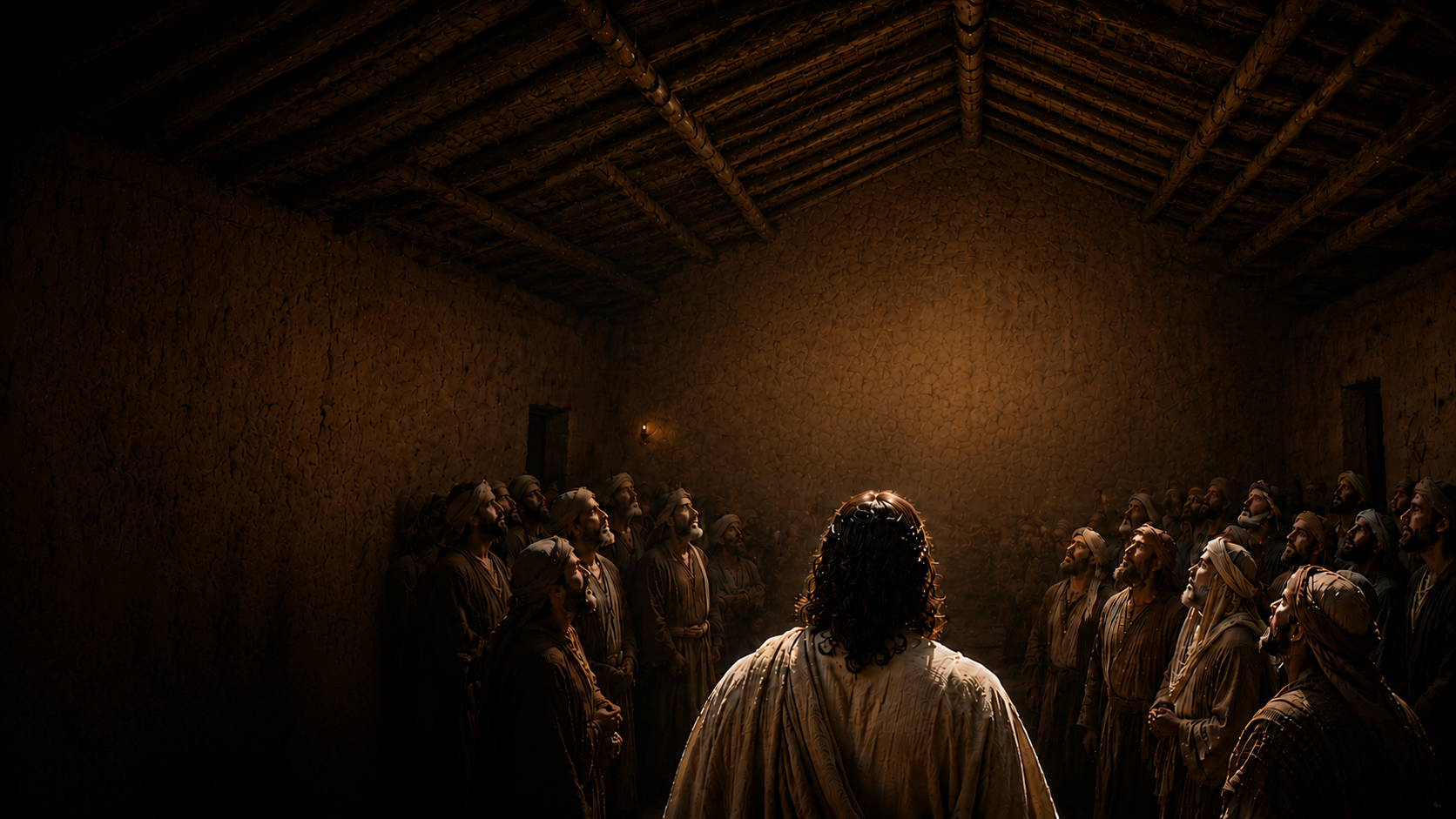
Jesus is teaching. Mark uses the imperfect tense, he was teaching, ongoing action, not a brief drop-in.
The Word is being preached.
The house is full.
And then four men arrive carrying a fifth.
The Four Friends
The paralysed man they are carrying is entirely dependent on others. His limbs have failed him completely. And the crowd gathered to be near Jesus has become, entirely without meaning to, the obstacle between this man and the one who can help him.
Mark's irony here is quiet and devastating. The people of God, gathered around the presence of God, forming a barrier between a broken man and the healer.
But the four friends do not deliberate. They do not send a message asking Jesus to come outside. They go up onto the roof and break through it.
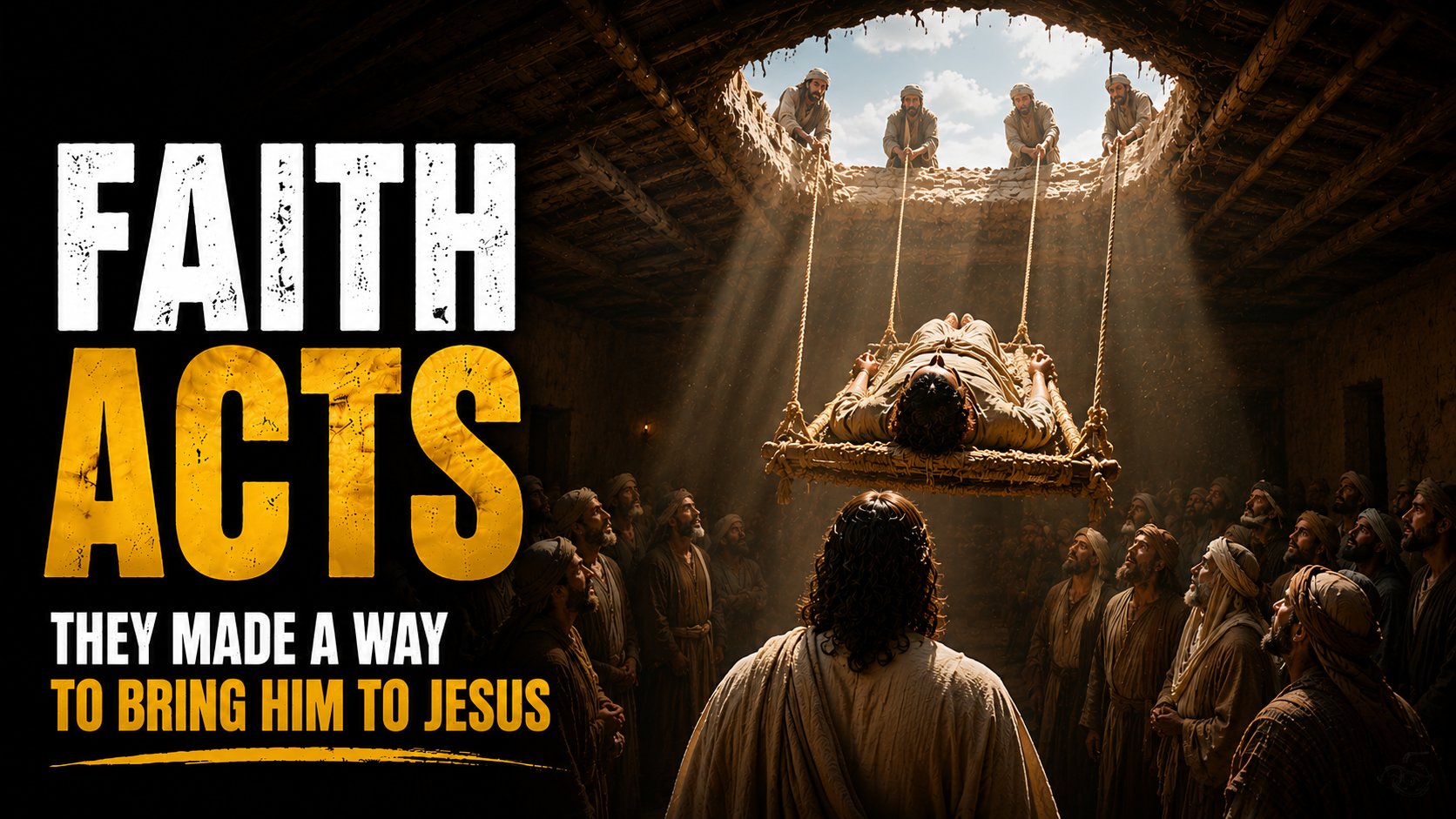
The Greek verb is vivid and physical: they dug through it, excavated it, broke it open. Packed earth and timber coming down into the room below. Dust in the air. The crowd looking up. Jesus still teaching.
And through the hole they have made, they lower their friend on his mat down into the presence of Jesus.
What Jesus Sees
Mark tells us that Jesus saw their faith. Not their theology. Not their credentials. Their faith, expressed in determined, obstacle-defying, roof-demolishing action.
And then Jesus says something nobody in the room is expecting.
Child. Your sins are forgiven.
Not be healed. Not get up. He goes somewhere deeper first. The word teknon, child, is a term of warm intimate address that appears nowhere else in any of Mark's healing accounts. Jesus is not addressing a case or performing a procedure. He is speaking tenderly to a person, establishing the relational register before anything else, which matters enormously to a man who has perhaps spent years thinking of himself as a burden rather than a human being.
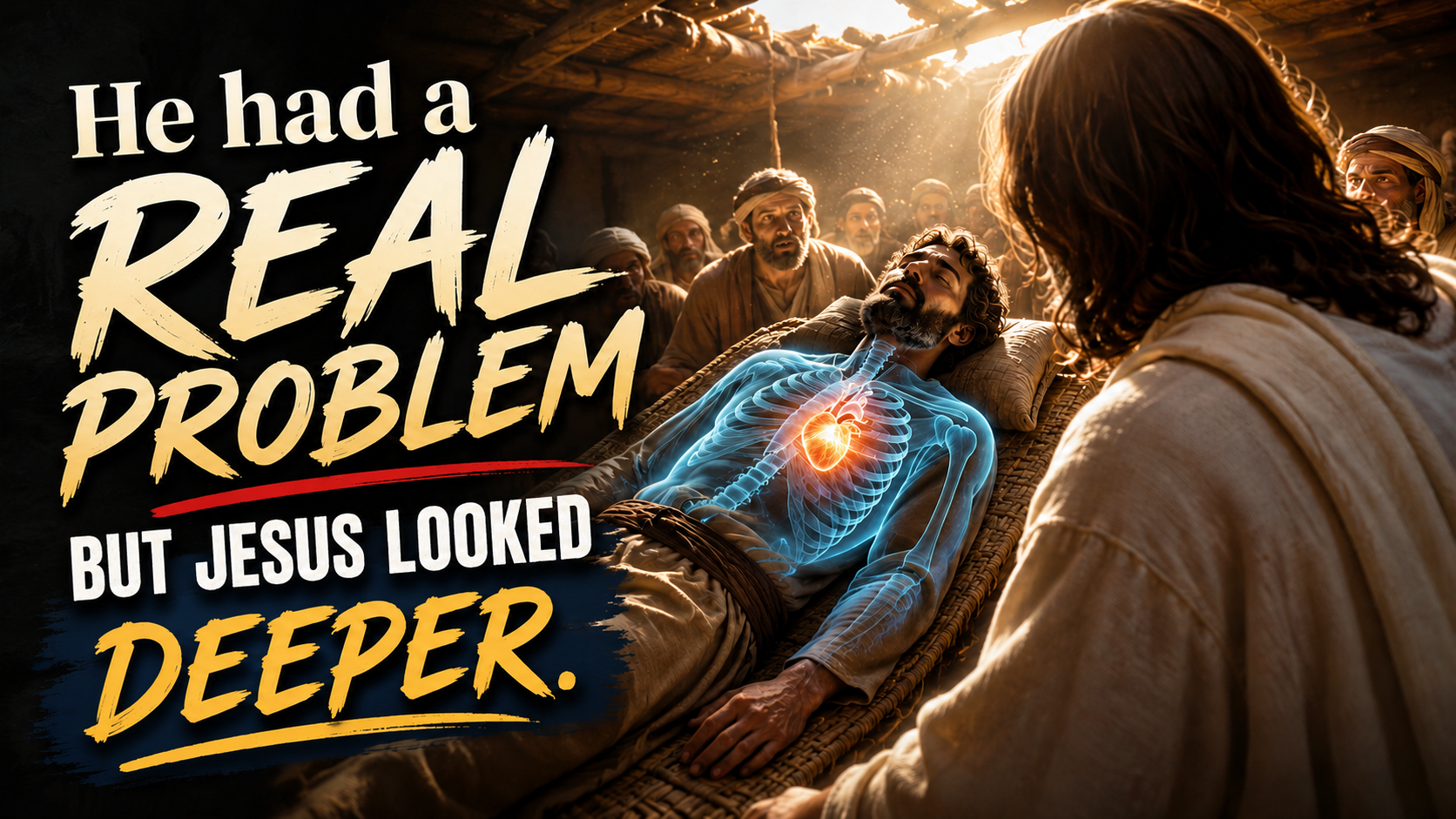
And then: your sins are forgiven. Present tense. Not a report of a divine decision made somewhere else. The forgiveness happens in the speaking of the word.
The Scribes Get the Theology Right
The religious scholars sitting in the corner understand immediately what has been claimed. Only God forgives sins. That was not a controversial statement in their world. It was straightforward theological fact, grounded in the whole temple system of Leviticus, the Day of Atonement, the priestly intercession. Forgiveness belonged to God alone.
So what they have just heard Jesus say is either the most extraordinary truth they have ever encountered, or it is blasphemy.
There is no middle ground available to them. And they choose blasphemy. Not because they have misread Jesus. Because they have heard him with perfect accuracy and drawn the only logical conclusion their framework allows.
Their theology is right. Their problem is that they do not yet know who they are dealing with.
The Question and the Proof
Jesus knows what they are thinking. He addresses them publicly with a question: which is easier to say, your sins are forgiven, or rise and walk?
At one level both sentences are equally easy to say. But only one is immediately verifiable. If you say your sins are forgiven, nobody can check. The claim floats. But if you say rise and walk to a paralysed man, the room finds out at once whether the authority behind the words is real.
So Jesus connects the two. So that you may know, he says, that the Son of Man has authority on earth to forgive sins, and then he turns to the man and tells him to get up, take his mat, and go home.
And the man does. Immediately. In front of everybody.
The healing is not the point. It is the proof of the point. The invisible thing, the forgiveness, is confirmed by the visible thing, the healing. You cannot separate them. The miracle is the signature on the declaration.
The Mat
At the beginning of the story, four men are carrying a paralysed man on a mat. At the end of the story, the paralysed man is carrying the mat himself.
His prison is in his hand and off he goes.
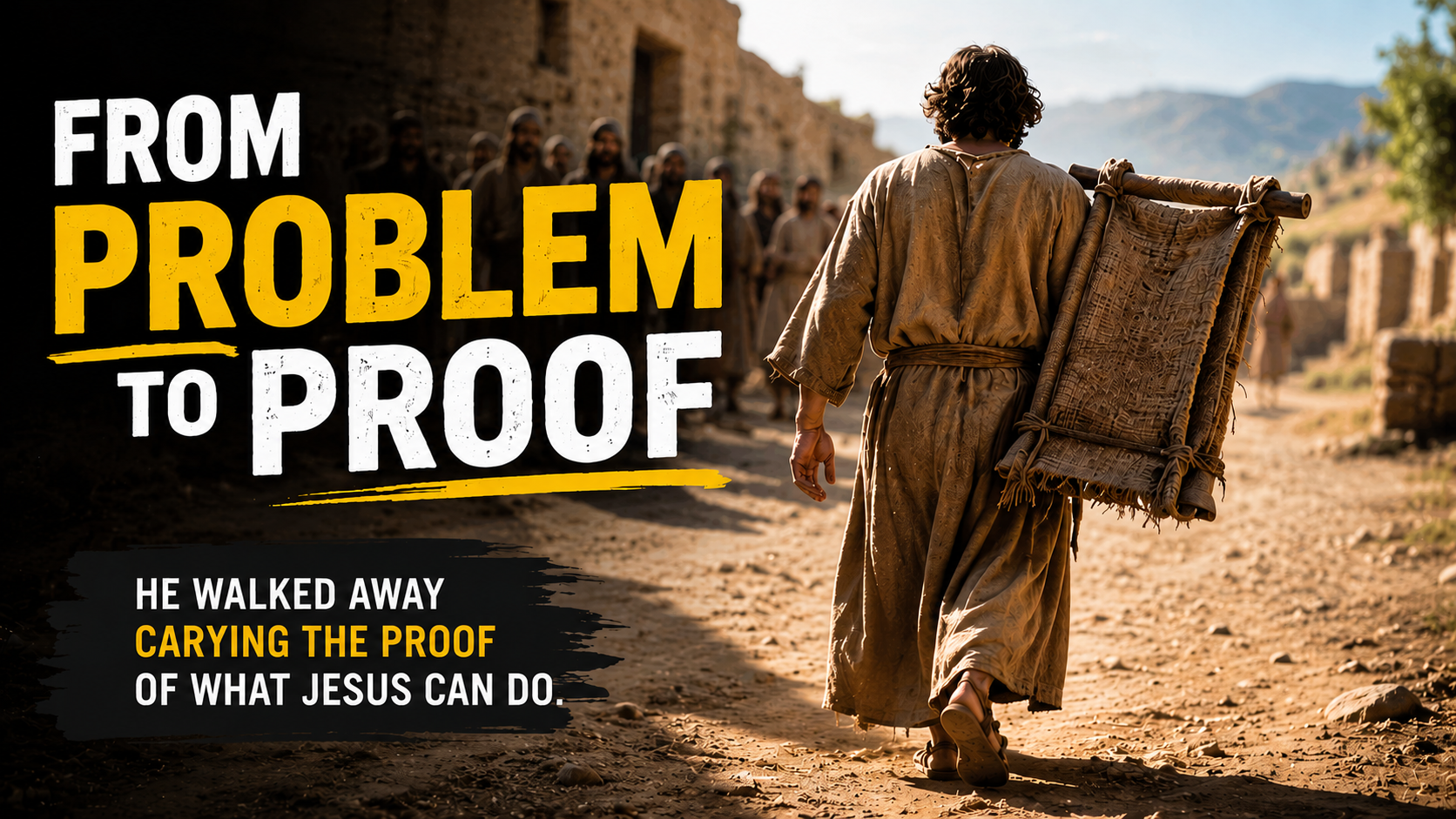
The thing that defined his helplessness is now the evidence of what Jesus has done for him. The story of how he arrived is now carried in his arms as he leaves. And the crowd's response, we never saw anything like this, is an honest statement of the facts. Nothing in their experience or memory provides a category for what has just happened.
They glorify God. Which is theologically interesting, because what they have just watched Jesus do is what the scribes said only God can do. Mark does not comment on the irony. He does not need to.
The Bigger Picture
This passage does not stand alone. It is one stage of a much longer argument Mark is building from chapter 1 verse 1 all the way to Peter's confession at Caesarea Philippi in chapter 8: you are the Christ.
Mark opens with his thesis statement. The beginning of the good news of Jesus Christ, the Son of God. Everything that follows is evidence. The authority question is raised in 1:22, deepened in 1:27, and receives its first decisive public answer in 2:10, in the form of a man walking out of a room carrying his mat.
The scribes asked the right question. Who does this man think he is? Mark's Gospel is the answer.
What Mat Are You Carrying?
Simon closes with the man on the mat, and so should we.
He came into that house unable to do anything for himself, defined entirely by what he could not do. He left carrying the mat himself.
The same Jesus who looked past the paralysis and the hole in the ceiling to the deeper need is still asking the question Mark has been building toward since the very first words of his Gospel. Who do you say that I am?
It is the most important question you will ever answer. And the evidence Mark has gathered for you is extraordinary. Read it for yourself, completely free, here:
https://live.bible.is/bible/ENGNLH/MRK/1
Start at chapter 1. Keep reading. Let Mark make his case.
You can watch the full Word for the Week on this passage on the WelshRev YouTube channel, along with three Super Short Thought reels each taking a single point from this passage and landing it in under 90 seconds, including one filmed with the chaplaincy stretcher!
https://youtube.com/playlist?list=PL8_nqRcLJvtchcsemJU_0q1aL0wd69SQU&si=NxIPuPJxI3BQh0GN
Quiz: Mark 2:1-12 | A Question of Authority
These reminder questions are based on this week's Word for the Week and this companion blog post on Mark 2:1-12.
Some of them will send you back to the passage itself, which is exactly the point.
Open your Bible and have a look.
The answers are at the bottom.
Question 1
Mark uses the Greek imperfect tense to describe how the news spread that Jesus was at home in Capernaum. What does the imperfect tense suggest about the way the news travelled?
a) It arrived suddenly in a single announcement
b) It spread gradually in ripples as people kept hearing
c) It was deliberately kept secret by the disciples
d) It came through an official synagogue announcement
Question 2
The passage describes the paralysed man using a Greek word, paralutikos, that appears only in this section of Mark's Gospel. What does this tell us about his condition?
a) He had a mild weakness in one leg
b) He was blind as well as unable to walk
c) His limbs had failed entirely and he was wholly dependent on others
d) He had been paralysed since birth according to the text
Question 3
Simon drew attention to the grammatical structure of the opening section of the passage. In the early verses, the paralysed man is the grammatical object rather than the subject. Why does this matter?
a) It tells us he was considered unimportant by the crowd
b) It shows that things are done to him and for him and he has no independent action yet, which makes the reversal at the end of the story more powerful
c) It is simply a feature of Mark's style with no particular significance
d) It indicates he was unconscious when he arrived
Question 4
Jesus addresses the paralysed man with the word teknon before saying anything else. Why does this detail matter?
a) It tells us the man was a young boy rather than an adult
b) It is a formal legal term used in Jewish courts
c) It is a term of warm intimate address that establishes a personal relational register before the theological declaration
d) It is Mark's way of indicating that Jesus adopted the man as a disciple
Question 5
The scribes reasoned that only God could forgive sins. In the framework of Second Temple Judaism, through what means was forgiveness of sins normally obtained?
a) Personal prayer and fasting alone
b) The temple cult, the Day of Atonement, priestly intercession, and the sacrifice system of Leviticus
c) The decision of the local synagogue elders
d) A prophetic declaration made in God's name
Question 6
Jesus asks the scribes which is easier to say: your sins are forgiven, or rise and walk. What is the point of this question?
a) Jesus is asking the scribes to vote on which miracle they prefer
b) Jesus is suggesting that healing is always harder than forgiving
c) The forgiveness claim cannot be publicly verified while the healing can, so the healing will serve as evidence for the forgiveness
d) Jesus is testing the scribes' knowledge of the Law of Moses
Question 7
When Jesus says the Son of Man has authority on earth to forgive sins, the phrase on earth is theologically significant. Which of the following best captures what this means in context?
a) It means that Jesus could only forgive sins during his earthly lifetime
b) It means that forgiveness, previously associated with the heavenly court and the temple, is now being enacted in ordinary human space through the ministry of Jesus
c) It is simply a geographical note indicating that this is happening in Galilee rather than Jerusalem
d) It refers to the authority given to the disciples in Matthew 16
Question 8
At the end of the passage the healed man carries his mat out of the house. Simon describes the mat as going from being the evidence of his need to being the evidence of what Jesus has done for him. What does this detail suggest about how Jesus deals with our past?
a) Jesus removes all memory of our past difficulties
b) Jesus expects us to leave our past behind entirely
c) Our history in Jesus' hands does not have to define us but can become the testimony of what he has done
d) The mat is simply a practical detail with no symbolic significance
Question 9
The crowd's response in verse 12 uses the Greek word exiistasthai, meaning to be beside themselves. This is described as the strongest term in Mark's vocabulary of crowd response. What does this suggest about the event they have witnessed?
a) The crowd was frightened and wanted to leave
b) The event exceeded every category and framework available to them for understanding it
c) The crowd was confused because they had missed the theological argument
d) Mark is exaggerating for dramatic effect
Question 10
Simon described the authority question as a thread running through Mark chapters 1 and 2. Match each verse to the way the authority question appears in it.
Mark 1:22: The crowd is astonished because Jesus teaches as one having authority and not as the scribes.
Mark 1:27: Even an unclean spirit recognises and questions the new teaching with authority.
Mark 2:10: The Son of Man is declared to have authority on earth to forgive sins, confirmed by a public miracle.
Which of the following statements best describes how these three moments relate to each other?
a) They are three unconnected episodes that happen to use the same word
b) Mark is building a progressive case through repeated use of the word exousia, moving from teaching authority to exorcistic authority to the authority to forgive sins, with the miracle confirming the claim
c) The authority question is resolved at 1:22 and the later passages simply repeat the same point
d) Mark uses the word authority only because it was the most common word available to him
Reflection Question
What is the mat you are carrying into this week, and what would it mean to walk out carrying it differently?
Answer Key
1-b, 2-c, 3-b, 4-c, 5-b, 6-c, 7-b, 8-c, 9-b, 10-b.
Please feel free to get in touch using the contact opportunity on this website.
Rock, Empire and the Question That Changed Everything - Mark 8:27-38